
Why Mexico Could Be Untouchable in the Knockouts at 7,200 Feet
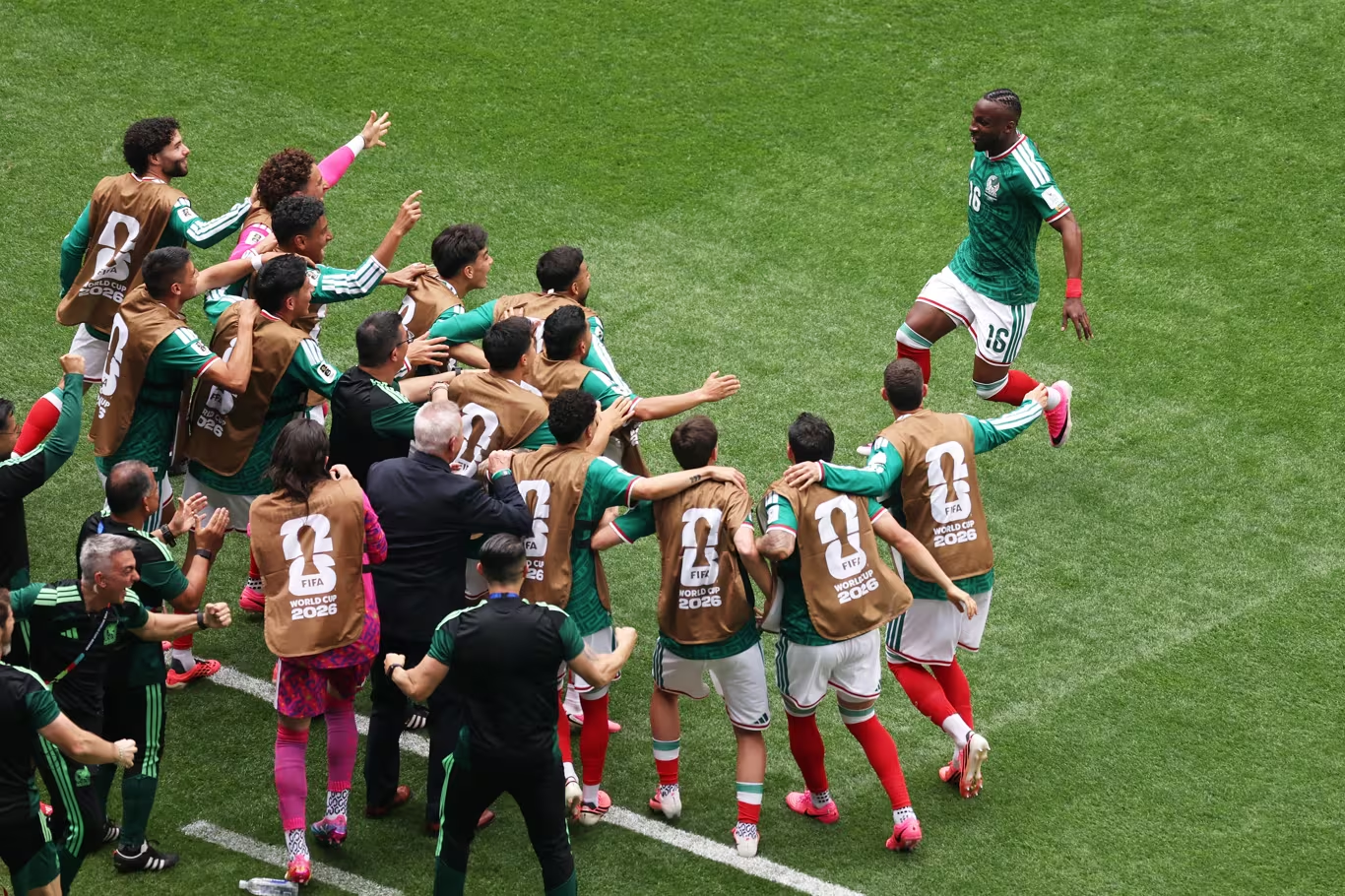
Table of Contents
There is a number that should frighten every team still alive at this World Cup, and it has nothing to do with form, squad value or world ranking. It is 7,200. That is the height in feet of Mexico City, where the rebuilt Azteca sits some 2,200 metres above sea level, and where the air itself becomes an opponent that no amount of tactical preparation can fully tame. As the tournament moves toward the knockout rounds, Mexico’s path may run straight through that thin air, and history suggests that is very bad news for anyone forced to follow them up the mountain.
Mexico have hosted the World Cup twice before, in 1970 and 1986, and on both occasions they reached the quarter-finals. That is not a coincidence. It is the altitude doing its quiet, ruthless work, sapping the legs of visiting teams while the home side breathes easy in conditions they have known their whole lives. If El Tri top their group and earn the right to stay in the capital for the early knockout games, they will carry an advantage that is invisible on the team sheet and decisive on the pitch.
What altitude actually does to a footballer
The science is unforgiving. At 7,200 feet, the air holds significantly less oxygen than it does at sea level, and the human body cannot simply will its way around that fact. Players who have not spent weeks acclimatising experience a faster onset of fatigue, higher heart rates at any given running intensity, and a reduced capacity to sustain the repeated high-intensity bursts that define modern international football. The pressing, the recovery runs, the late surges that win tight games all become harder to produce when every breath delivers less fuel.
There is the air quality to contend with as well. Mexico City’s sprawling capital is not only high but often hazy, and opposition players accustomed to cleaner, denser air at sea level can find the combination disorienting. The ball itself behaves differently in thin air, flying faster and further, turning shots and long passes into unpredictable events. For a team arriving with only a few days to adjust, there is no real solution. You cannot train your blood to carry more oxygen in 72 hours, and you cannot fake your way through ninety minutes when your body is screaming for air it cannot find.
The numbers behind a haunting home record
History keeps telling the same story. In both 1970 and 1986, Mexico went unbeaten at the Azteca, posting two wins and a draw on home turf each time, and the only blemishes came when they were dragged away from the capital to play elsewhere. Strip away the matches at altitude and Mexico’s World Cup record looks ordinary. Add them back in and a clear pattern emerges: at home, in the thin air, against teams gasping to keep up, El Tri become a far more dangerous proposition than their talent alone would suggest.
That is the prize on offer again. The format of the 2026 tournament means a group winner can be rewarded with a run of knockout fixtures close to home, and for Mexico that could mean staying in Mexico City through the Round of 32 and into the Round of 16. Two knockout games at 7,200 feet, against opponents flying in from sea-level host cities with barely time to adjust, is the kind of edge that turns a good team into a quarter-finalist almost regardless of who lines up against them.
The opponents who should fear the climb
The teams who would suffer most are precisely the ones built on relentless running and high pressing. Sides that rely on swarming opponents, winning the ball high and overwhelming teams with energy will find their game plan throttled by the altitude. There is a scenario, much discussed already, in which England could be drawn to Mexico City for a Round of 16 tie, and it is exactly the sort of fixture that can quietly undo a favourite. A team used to controlling games through intensity suddenly cannot sustain the intensity, and the match slips into a rhythm that favours the locals.
For the visiting coach, the choices are all bad. Press hard and risk burning out before the hour mark. Sit deep and conserve energy, and hand Mexico the control they crave in front of a roaring home crowd. There is no comfortable middle ground at altitude, and the home side knows it. Mexico do not need to be the most gifted team left in the tournament. They need only to be the team that can still run when everyone else is bent over double, hands on knees, sucking at air that will not come.
A stadium soaked in World Cup history
The setting only deepens the aura. The Azteca is the only stadium to have hosted two World Cup finals, the stage on which Pele lifted Brazil to glory in 1970 and Diego Maradona produced both the Hand of God and the greatest individual goal the tournament has ever seen in 1986. To play a knockout match there is to step into the most storied arena in the sport, with the weight of those ghosts pressing down alongside the altitude. For Mexico’s players, that history is a comfort and a calling. For visitors, it is one more psychological hurdle stacked on top of the physical ones.
Reborn and modernised for this tournament, the ground retains the intimidating bowl shape and the wall of sound that made it feared for generations. A Mexican knockout night at the Azteca, with the crowd in full voice and the thin air doing its work, is as close to a guaranteed home advantage as exists anywhere in world football. It is the sort of environment where reputations wobble and underdogs are born.
Why the rest of the field should be paying attention
The wider point is that this World Cup is not played on a level field, literally or figuratively. The decision to spread the tournament across three nations and a vast range of climates and altitudes has created pockets of advantage that the bracket will reward or punish almost at random. A team’s path counts for as much as its quality, and few paths carry a built-in edge as stark as Mexico’s potential run through the capital. The teams plotting their route to the final are not only studying opponents. They are studying maps and elevation charts, hoping to avoid the one fixture that strips away everything they are good at.
For neutrals, it adds a delicious layer of jeopardy. The biggest names in the tournament could find their summer ended not by a better team but by a thinner sky, undone by ninety minutes in a place where the human body simply cannot do what it does at sea level. That is the threat Mexico carry into the knockouts, and it is one no opponent can train away.
The mountain waiting at the heart of the tournament
So as the favourites jockey for seeding and supporters debate brackets, the quiet truth sits there at 7,200 feet. Mexico may not be the most talented team left standing, but they could be the most dangerous, armed with an advantage as old as the Azteca itself and as immovable as the ground it stands on. Twice before, the altitude carried them to the last eight. Twice before, visitors arrived confident and left gasping.
If El Tri top their group and the bracket sends their knockout games to the capital, the rest of the field has been warned. The hardest opponent at this World Cup may not wear a shirt at all. It may simply be the air, and the team that has spent its whole life learning to breathe it.
First, Mexico have to earn the climb
None of this advantage means a thing unless Mexico hold up their end of the bargain. The altitude is only a weapon if El Tri finish top of their group and keep their knockout fixtures in the capital, and that is far from guaranteed in a tournament where the host nation carries the heaviest expectation of all. A second-place finish, or a quirk of the bracket, could drag them away from the Azteca and to a sea-level venue where the playing field flattens out and the edge disappears. The pressure on this Mexico side is to take care of business in the group and protect the one thing no opponent can replicate.
There is a human dimension to that pressure too. Mexican football has lived through years of frustration on the biggest stage, of round-of-16 exits and the sense of a nation forever pushing at a ceiling it cannot break. A home World Cup, with the altitude on their side and the Azteca roaring behind them, is the best chance a generation of Mexican players will ever get to finally smash through it. The supporters know it. The federation knows it. And the weight of that expectation can be as heavy as the thin air is helpful, a reminder that home advantage cuts both ways when the whole country is watching and hoping.
Still, of all the burdens a host can carry, a built-in physical edge is the one most teams would happily take. If Mexico can manage the nerves and finish first, the climb becomes theirs to defend, and the rest of the tournament has to come and find them in the clouds. That is a position of strength that no amount of money or pedigree can buy. It has to be lived, breathed and earned at 7,200 feet, and Mexico have been earning it their entire lives.

Leave a Comment
More in News

Illinois woman gets orange soda from gas station soda fountain. Then she sees what else came with it: ‘Imagine you got a Coke’
Cristiano Ronaldo Celebrates 982nd Career Goal That Opta Calls an Own Goal

Roberto De Zerbi Defends Spurs Medical Staff Amid Growing Injury List

California Woman Orders Ice Cream From Baskin Robbins. Then She Removes Single Cherry—And Sees How Much Her Total Goes Up

Texas man goes to Nordstrom Rack. Then he notices something strange about all the shoes: ‘Recession indicator’
Trending on Futbol Chronicle

Map of All the Premier League Teams for 2025/26
What Is Offsides in Soccer? The Offside Rule Fully Explained
Celta Vigo postpones LaLiga opener after fungus outbreak damages stadium pitch
Why Soccer Is The Best Sport