
Mexico City’s World Cup Party Stands on the Ground Where Tenochtitlan Once Rose
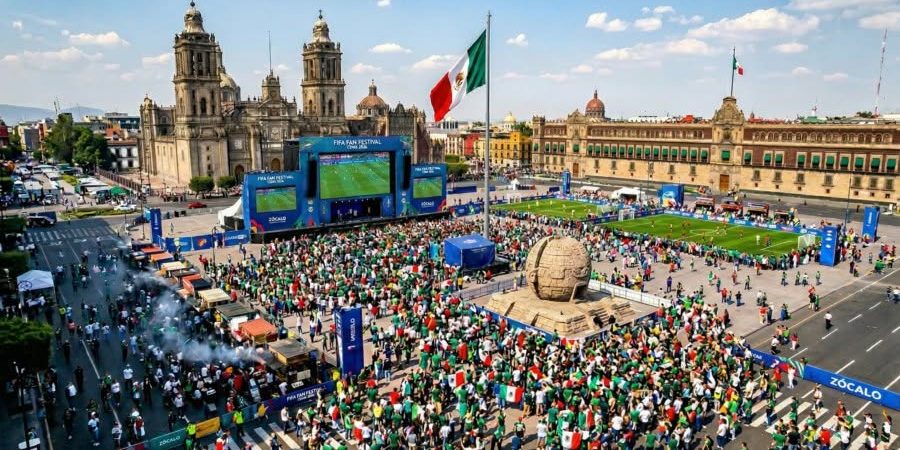

Table of Contents
Seven centuries ago, the ground beneath Mexico City’s main square held the ceremonial heart of Tenochtitlan, the island capital of the Aztec empire, where tens of thousands gathered for rituals that bound a civilisation together. From June 11 to July 19, that same ground hosts a different kind of ceremony. The Zocalo, the vast plaza framed by the Metropolitan Cathedral and the National Palace, has been transformed into the largest FIFA Fan Festival of the 2026 World Cup, a free, 39-day football gathering that organisers say can hold tens of thousands of people a day. FIFA’s own promotional material leans into the history, describing a new sacred space rising where the Aztecs built their city: the sacred space of football.
The People’s Stadium
The scale of the operation is remarkable even by World Cup standards. Every one of the tournament’s 104 matches will be shown live on what organisers describe as one of the largest screens in the world, with entry free for the entire run from the opening match to the final. Live music and DJs fill the gaps between fixtures, local food stalls ring the square, and an exhibition of the Mesoamerican ball game connects the modern tournament to the region’s oldest sporting tradition, a game played on this land thousands of years before football existed.
Mexico City’s government has wrapped the Fan Festival inside an even bigger programme. The city has lined up more than a thousand official activities for the tournament, from concerts to dance and street performances, including free Football Festivals with big screens in neighbourhoods across the capital, aimed directly at residents priced out of stadium tickets.
“We are organising a World Cup for the people,” Mayor Clara Brugada said in announcing the plans, a phrase that has become the unofficial slogan of the city’s tournament.
A Parade for the Ages
Two days after the opening match, the celebration spills out of the square and onto Paseo de la Reforma, the grand avenue that cuts through the city. Brugada’s office has organised a Great World Cup Parade for June 13, running from the Diana Cazadora roundabout to the Monumento a la Revolucion.
The procession is a deliberate festival of Mexican popular culture. A Day of the Dead tribute will honour Diego Maradona and Pele, the two giants who defined the World Cups Mexico hosted in 1986 and 1970, with alebrijes, catrinas and a Xochimilco trajinera carrying their memory down the avenue. Giant balloons modelled on past tournament mascots will float above the route alongside the flags of the 48 qualified nations. And in a touch that could only happen in Mexico City, Sonido La Changa, the legendary sound system that has soundtracked the capital’s street parties for decades, is set to play cumbias and salsas from one of the floats.
The opening night set the tone. After Mexico kicked off the tournament against South Africa at Estadio Banorte, with an opening ceremony featuring Mana, Belinda, Lila Downs, Shakira and Andrea Bocelli, the party moved to the Zocalo, where Banda El Recodo headlined the Fan Festival stage.
Thirteen Cities, One Square
FIFA is running Fan Festivals in 13 host cities across the United States, Mexico and Canada this summer, the most in tournament history, surpassing the 12-venue editions in Germany in 2006 and Brazil in 2014. Each site has its own character. Toronto leans on its World in a City theme, Guadalajara sells itself as the soul of the game, and Kansas City has built its festival around its barbecue culture.
But the Zocalo is the flagship, and not only because of its size. No other fan zone in North America sits on ground with this much history. The square has been the centre of Mexican public life since before Hernan Cortes arrived, and it has absorbed everything from imperial coronations to revolutions to papal masses. A month of football broadcast to a sea of green shirts is simply the latest chapter, and for a country hosting its third World Cup, the first nation ever to do so, the symbolism is potent. Mexico 1970 and Mexico 1986 live in football memory as two of the great tournaments. The 2026 edition is shared with two neighbours, but the Zocalo is where its heart beats loudest.
The tournament’s opening days have already produced their share of Mexican storylines, including the rise of Tijuana’s teenage playmaker Gilberto Mora, who turned down European interest to stay home before the World Cup. If El Tri make a deep run, the square’s capacity will be tested in ways no screen size can fix.
The Shadow Over the Party
It has not all been festival planning. The build-up in Mexico City has been complicated by escalating protests from the CNTE teachers’ union, whose demonstrations have blocked major avenues and, in scenes that travelled around the world, toppled World Cup player statues installed along Reforma. The tension was serious enough that FIFA moved volunteer training for the Zocalo site online in early June, citing security concerns.
City and federal officials insist the events will be protected, and Mexico has deployed an enormous security operation for the tournament. President Claudia Sheinbaum used her morning press conference to guarantee safety for visiting fans. The stand-off is a reminder that a World Cup always lands on top of a country’s existing politics rather than replacing them, and that a free festival in the centre of a capital city is both a gift to residents and a stage for anyone with a grievance to air.
There is also the harder question underneath the celebrations. Match tickets for this World Cup are the most expensive in the tournament’s history, and for most of the 22 million people in greater Mexico City, attending a game at the Estadio Banorte is financially out of reach. The free festival is the city’s answer to that gap, an attempt to fold ordinary residents into an event that might otherwise happen behind a paywall in their own city.
What a Square Can Hold
Fan festivals have been part of World Cup furniture since Germany 2006, when the fan mile in Berlin proved that the tournament’s most memorable images do not all come from inside stadiums. Two decades on, the model has matured into something cities compete over, because the festival, not the stadium, is where most locals will actually experience the World Cup.
Mexico City seems to understand this better than anyone. The capital has hosted two World Cup finals, and in both 1970 and 1986 the lasting images included the crowds in the streets as much as Pele’s Brazil or Maradona’s Argentina. The Zocalo festival is a bet that the same alchemy can happen a third time, with the square itself as the protagonist.
For the next five weeks, the ground where Tenochtitlan stood will fill each day with fans watching football for free under the open sky, between a cathedral built from the stones of a destroyed empire and the palace where the country is governed. Stadiums get demolished and rebuilt. Tournaments come and go. The square remains, absorbing one more ritual into seven hundred years of memory. Football should feel lucky to be invited.

Leave a Comment
More in News

Nottingham Forest Agree £22m Deal to Reunite Daniel Munoz With Oliver Glasner

Moyes Says Everton Supporters Are Not Wrong to Fear Losing Harrison Armstrong

Iraola Faces Alexander Isak Puzzle as Liverpool Search for Their First Win

De Zerbi Admits Finding the Right Mentality Is Tottenham’s Biggest Challenge

Emiliano Martinez Closes In On Chelsea Move After Robert Sanchez Error
Trending on Futbol Chronicle
Why Soccer Is The Best Sport
The Best World Cup YouTubers to Follow in 2026

Michael Carrick admits Manchester United have “no excuses” after AC Milan defeat
Cristian Romero completes €40m move from Tottenham to Atlético Madrid