England Lost Two Right Backs to Injury Before the DR Congo Knockout
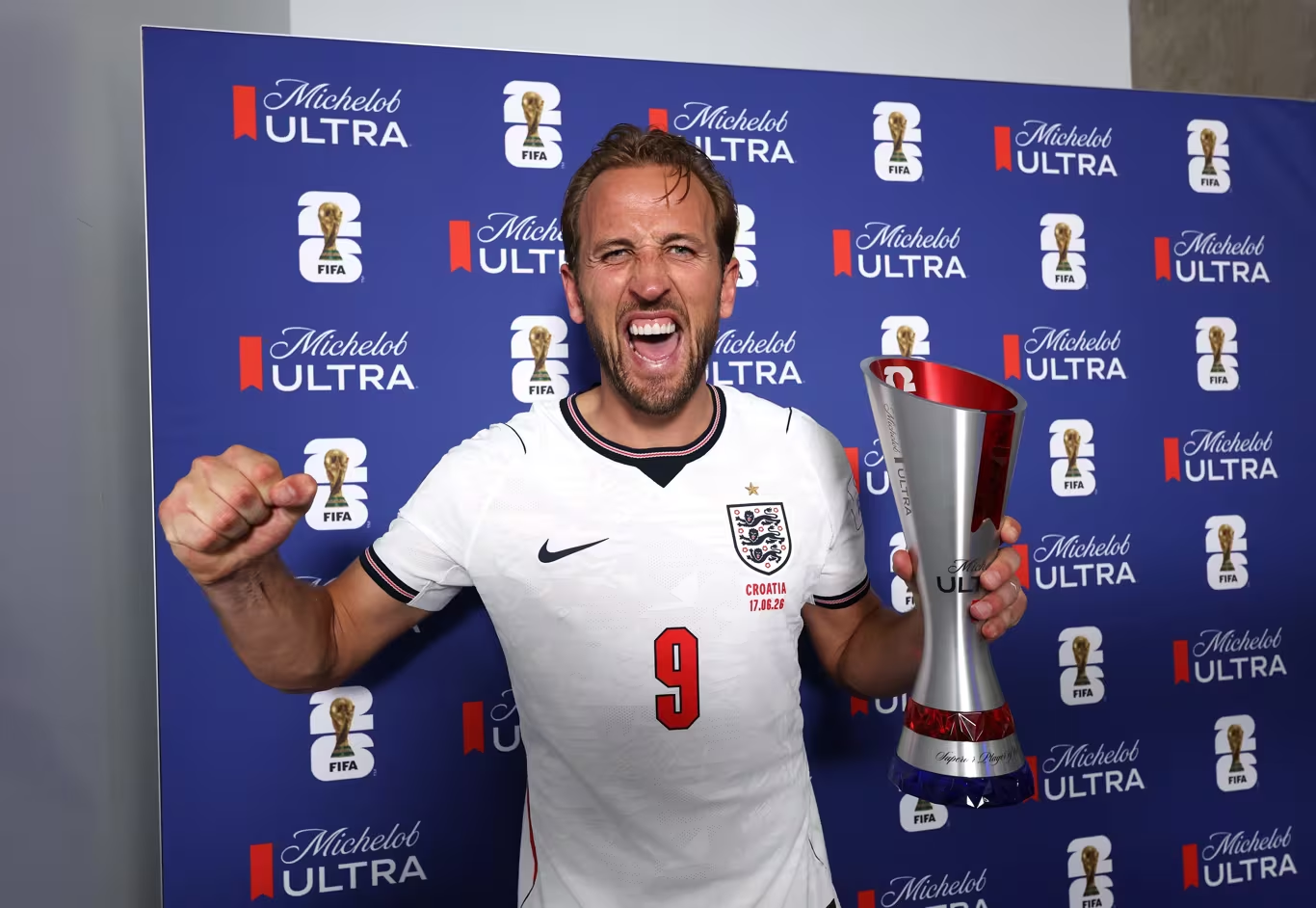
Table of Contents
Not long ago, right back was the position England could not stop producing. Kyle Walker, Kieran Trippier, Trent Alexander-Arnold, Reece James, Reece James again in a different, better version of himself. Managers agonised over which top-class option to leave out. On the morning of a World Cup knockout tie against DR Congo, Thomas Tuchel has the opposite problem. He walks into the biggest game of England’s tournament without a single recognised right back fit to play there.
Reece James, the Chelsea captain and Tuchel’s first choice, limped out of the goalless draw with Ghana holding his hamstring. The early prognosis is bleak enough that he may not feature again at this World Cup. Jarell Quansah, one of the emergency options, has an ankle problem and misses the DR Congo game too. Tino Livramento, the designated backup, withdrew before the tournament even began with a hamstring injury of his own. Three right backs, three injuries, and a last 32 tie at the Mercedes-Benz Stadium in Atlanta to solve without them.
How a position of plenty became a crisis
The speed of the collapse is what stings. England arrived in North America with a defence that looked settled and deep, the right side in particular covered several times over. Tuchel could name James as his starter and know that Livramento, a rising talent at Newcastle, sat behind him. Quansah and Ezri Konsa offered further cover, defenders comfortable filling in on the right when asked. It was the kind of depth most nations envy.
Injuries do not respect a depth chart. Livramento went first, pulling out before the opener and forcing Tuchel into a late reshuffle. James lasted until the second group game before his hamstring gave way, a cruel blow for a player whose career has been repeatedly interrupted by exactly these problems. Quansah’s ankle completed the sequence. What began as an embarrassment of riches became, inside a fortnight, a genuine selection headache with no clean answer.
Tuchel’s makeshift menu
The most obvious replacement is Djed Spence, except Spence is not really a right back anymore. He has spent the season at Tottenham playing on the left, and England selected him in this squad as cover for Nico O’Reilly at left back. Asking him to switch flanks for a knockout tie is possible, but it means moving a player out of the role he has grown comfortable in and into one he has not started regularly in some time.
Konsa is the other candidate, and Tuchel rates him there. The Aston Villa man is first choice in the middle of England’s defence, but he has filled in at right back for his country before, and the manager spoke warmly about how well he performed in the role. Using Konsa on the right, though, means weakening the centre, pulling a key defender out of the position where England most need him against a DR Congo side that carries a real aerial and transitional threat.
Then there is Trevoh Chalobah, and his call up tells its own story. Tuchel summoned the Chelsea defender specifically, he explained, to free up Quansah for right back duty. “The thinking of calling Chalobah is to free up Quansah on the right full back position for us,” the manager said, adding that he had watched Quansah “playing very strongly there for Liverpool” in a back three. That plan lasted only as long as Quansah’s ankle held up. Now Chalobah is cover for a centre back role, and the right back problem is back on Tuchel’s desk.
Why DR Congo make it worse
A patched together full back would be a manageable worry against a limited opponent. DR Congo are not that. The Leopards reached the knockout stage for the first time in their history by holding Portugal, pushing Colombia close and coming from behind to beat Uzbekistan. They attack with pace and directness, and Yoane Wissa, their Newcastle forward, has three goals at the tournament, level with Harry Kane. A defender out of position on the right is precisely the sort of weakness a team like this is built to exploit.
Wissa knows English football intimately from his years in the Premier League. He has spent seasons studying the very defenders England might now deploy in unfamiliar roles. If Spence is caught between two positions, or Konsa is dragged out of the centre, DR Congo have the runners to punish it. Tuchel’s selection at right back is not a formality to be waved through. It could decide the tie.
The manager who keeps finding answers
If there is comfort for England, it lies in the man making the call. Tuchel has yet to lose a competitive match as England manager, winning ten and drawing one of his eleven games that carried stakes. He inherited a team heavy with talent and light on structure, and he has spent his reign imposing order on it. The right back puzzle is the kind of problem that has undone England managers before, and Tuchel has so far shown a knack for turning awkward situations into functional ones.
His options, for all the hand wringing, are still Premier League defenders. Spence started a European final this season. Konsa has been one of the most reliable centre backs in England for years. Chalobah has won trophies at Chelsea. This is not a nation scraping the barrel. It is a nation that had four good answers to one question and lost three of them to the treatment table at the worst possible moment.
Declan Rice returns to the midfield against DR Congo after sitting out the Panama match to manage a calf issue, one piece of good news in a week of bad. His presence in front of the back four offers protection, a shield that can help cover for whoever ends up at right back. A settled, disciplined midfield is one way to hide a makeshift full back, and Rice is central to that.
What the knockouts will reveal
England’s route to the final was always going to test the squad’s depth. Tournaments are won by teams that survive their injury crises, not by teams that avoid them, and every serious contender eventually has to cover a hole it did not plan for. How Tuchel solves the right back problem, and whether his solution holds against DR Congo and beyond, will say a great deal about how far this England side can go.
There is a broader lesson buried in it too. England spent years being told their golden generation of full backs was a permanent luxury, a position they would never have to worry about. Careers are fragile, and depth evaporates faster than anyone expects. Alexander-Arnold did not make this squad. James may be finished for the tournament. The riches were real, and they were also, it turns out, temporary.
The call that shapes the run
Tuchel will name his side, and someone will walk out at right back who did not expect to start there a month ago. Whether it is Spence switching flanks, Konsa sacrificing the centre, or another solution the manager has kept to himself, the choice carries weight beyond one game. Get it right and England move on with their structure intact. Get it wrong against a DR Congo team that punishes hesitation, and a tournament full of promise could end in Atlanta.
The position that once gave England too many options now gives Tuchel almost none. He has built a reputation on finding answers where others see only problems. On Wednesday, against a team with nothing to lose, he needs one more.

Leave a Comment
More in News

Thierno Barry Was Filmed Crying In A Private Training Session Last Season, And He Has Already Scored In Three Games This Campaign
Gravenberch’s Red Card Sparks Referee Row in Liverpool’s Defeat to City

Moise Kean Will Miss Como’s Biggest Game of the Season After Cesc Fabregas Clashed With Italy’s Doctors
Oliver Glasner Returned to Crystal Palace and Fans Turned From Applause to Taunts as Forest Lost
Vinicius Red Card for Hair Pull Leaves Mourinho Snubbing the Press
Trending on Futbol Chronicle
Cristian Romero completes €40m move from Tottenham to Atlético Madrid
Michael Carrick points to lack of sharpness after Manchester United draw with West Ham
The Best World Cup YouTubers to Follow in 2026

Map of All the Premier League Teams for 2025/26