Cape Verde’s 40 Year Old Keeper Made Seven Saves to Stun Spain on Debut
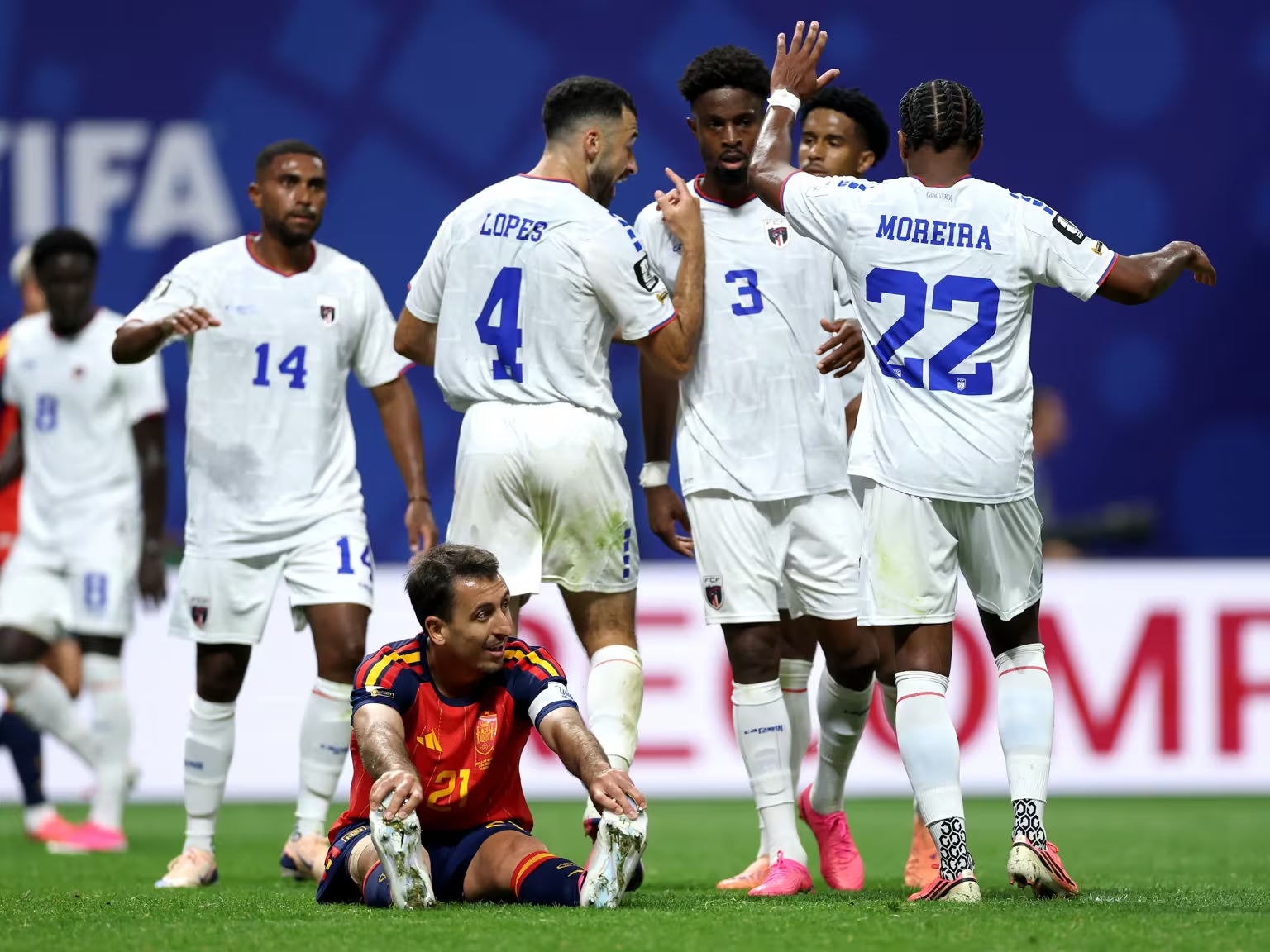
Table of Contents
Spain took 27 shots. They brought on Lamine Yamal, the teenager already spoken of as the best player on the planet, and pointed him at a defence that had no business holding firm. They had the European title, the possession, the budget, the history. And at the final whistle inside Atlanta’s Mercedes-Benz Stadium, the loudest noise in the building came from the Cape Verde end, where a few thousand supporters from a chain of islands with roughly half a million inhabitants sang and danced as if they had won the World Cup rather than drawn the opening game. At the centre of it stood a 40 year old goalkeeper who had just made the saves of his life.
The man they call Vozinha
His name is Josimar José Évora Dias, but nobody calls him that. He was raised by his grandparents in Cape Verde, and it was they who gave him the nickname Vozinha, which roughly translates as “little voice”. On Monday the little voice answered everything Spain could throw at him. He finished the match with seven saves, several of them the kind that change the temperature of a stadium, and he did it against a forward line that had been built to take title contenders apart, never mind a debutant nation ranked far below them.
Spain controlled the ball for long stretches and could not find the gap. When Yamal arrived from the bench in the second half, the expectation was that the breakthrough would follow. It did not. The teenager probed, Spain piled forward, and Vozinha kept getting in the way, reading flight and angle with the calm of a man who has spent two decades learning where a shot is going before it is struck. By the closing minutes the frustration on the Spanish bench was plain. A 0-0 draw flatters nobody on a scoreline, yet for Cape Verde it read like a statement.
The internet noticed before the players had left the pitch. Within a day, Vozinha had added millions of followers across social platforms, the modern measure of a man who has become an overnight folk hero. For a goalkeeper who turned 40 this year and has played most of his career far from the European spotlight, the attention was a strange and sudden thing. The performance that earned it was not strange at all to anyone who had watched him hold a defence together before.
A nation of half a million
To grasp what this result means, start with the numbers. Cape Verde is an archipelago off the west coast of Africa with a population of around half a million, which makes it the third smallest nation by population ever to reach a World Cup. It has no deep professional infrastructure to rival the giants of the game, no academy production line feeding Europe’s biggest clubs. Much of its squad is drawn from the global Cape Verdean diaspora, players raised in Portugal, the Netherlands and beyond who chose to represent the islands of their family rather than the larger nations where they grew up.
That diaspora is the secret engine of this team. For decades, Cape Verdean families have spread across the Atlantic in search of work and opportunity, and football followed them. The result is a national side stitched together from players who could have lined up elsewhere but felt the pull of a smaller flag. When they qualified, it was celebrated not only in the islands but in Lisbon, in Rotterdam, in every city where Cape Verdean communities had put down roots. The draw against Spain belonged to all of them.
Inside the stadium, the imbalance in support made the noise from the Cape Verde end all the more striking. The crowd of more than 67,000 was dominated by Spain fans, as you would expect for one of the tournament favourites. Yet it was the Cape Verdean supporters who out sang them, and who kept the celebration going in the concourses long after the final whistle. There is a particular joy in a fan base that arrives expecting nothing and leaves with a story it will tell for the rest of its life.
The words of the coach
Pedro Leitão Brito, the Cape Verde coach, framed the result in terms that went well beyond football. “This means everything for our country,” he said afterwards. He spoke about what his players had shown on the pitch, the organisation and the bravery, and he tied it to something larger about where they come from. The performance was, in his words, “proof of what our country is about, resilience and to try to overcome hardships”.
That is not the language of a manager talking about a defensive shape. It is the language of someone who understands that a small nation’s appearance on the biggest stage carries a weight that has nothing to do with tactics. Cape Verde’s history is one of migration, distance and making do with less, and Brito drew a straight line from that history to the way his team defended for 90 minutes against a side that should, on paper, have brushed them aside.
A goalkeeper at the end of a long road
What makes Vozinha’s afternoon so resonant is the age on the back of his shirt. Goalkeepers can play deep into their thirties, but 40 is the far edge of even that long horizon, and most men his age have long since hung up their gloves. He has spent a career mostly out of the European limelight, building the reading of the game that only decades between the posts can teach. On the biggest day of his footballing life, that experience was the difference. Younger keepers might have been beaten by the weight of the occasion or the relentlessness of the Spanish attack. He simply kept doing his job.
There is a lesson in that for a sport obsessed with youth. Cape Verde did not have the resources to assemble a squad of rising stars, so they leaned on the steadiness of a veteran who had seen everything the game could show him. Against a Spain side packed with players barely half his age, the oldest man on the pitch was the calmest, and his calm spread through the team in front of him. Big tournaments tend to reward composure, and composure is the one thing a 40 year old goalkeeper is never short of.
For Vozinha personally, the reward was instant and overwhelming. A man who had played most of his career in relative anonymity went to sleep on Monday with a global audience suddenly aware of his name, and the millions of new followers were only the visible part of it. He had given his country its first World Cup point and given himself a place in its sporting story that no number of quiet seasons could ever have bought.
Not quite the shock it seems
There is a temptation to file this under pure fairytale, the tiny nation that fluked a point against a superpower. The truth is more interesting. Spain have a long standing habit of starting World Cups slowly, a pattern that stretches back across several tournaments where they laboured in their opening fixtures before finding rhythm. A cautious, well drilled opponent who defends the box and trusts a goalkeeper in form is exactly the kind of test that has tripped Spain up before. Cape Verde did not stumble into this result. They built it, with a plan, and executed it for the full match.
What made it possible was the combination of a disciplined back line and a goalkeeper having the afternoon of his career. Defensive organisation can frustrate a great team for an hour. Sustaining it for 90 minutes against 27 shots requires a last line that does not blink, and Vozinha did not blink once. The shape held because the man behind it kept turning likely goals into corners and saves, and a structure is only as good as the keeper who covers its mistakes.
What it means for the tournament
A single point in a group stage rarely reshapes a World Cup, but a result like this changes the texture of the whole tournament. It tells every other smaller nation that the gap can be bridged for an afternoon if the plan is right and the nerve holds. It puts pressure back on Spain, who now have to chase points they expected to bank. And it gives the competition one of those early stories that fans carry with them, the kind that turns a neutral into a supporter of a team they could not have placed on a map a week ago.
For Cape Verde the work is not finished. A draw with Spain guarantees nothing, and the group will demand more from a squad that cannot rely on Vozinha producing seven saves every match. But they have already done the thing that small nations dream about. They walked onto the World Cup stage for the first time, stood toe to toe with the European champions, and walked off with a point and the loudest celebration in the building.
Somewhere in Cape Verde, in the islands where a boy raised by his grandparents was once handed a nickname meaning “little voice”, they will have watched a 40 year old version of him silence a stadium. The smallest of voices, it turned out, could be heard all the way across the Atlantic.

Leave a Comment
More in News

Nottingham Forest Agree £22m Deal to Reunite Daniel Munoz With Oliver Glasner

Moyes Says Everton Supporters Are Not Wrong to Fear Losing Harrison Armstrong

Iraola Faces Alexander Isak Puzzle as Liverpool Search for Their First Win

De Zerbi Admits Finding the Right Mentality Is Tottenham’s Biggest Challenge

Emiliano Martinez Closes In On Chelsea Move After Robert Sanchez Error
Trending on Futbol Chronicle

Map of All the Premier League Teams for 2025/26

Josef Martinez Returns to MLS Spotlight With Columbus Crew Signing

Why Soccer Is The Best Sport

Michael Carrick points to lack of sharpness after Manchester United draw with West Ham