Balogun Cleared to Play Belgium After FIFA Lifts Red Card Ban
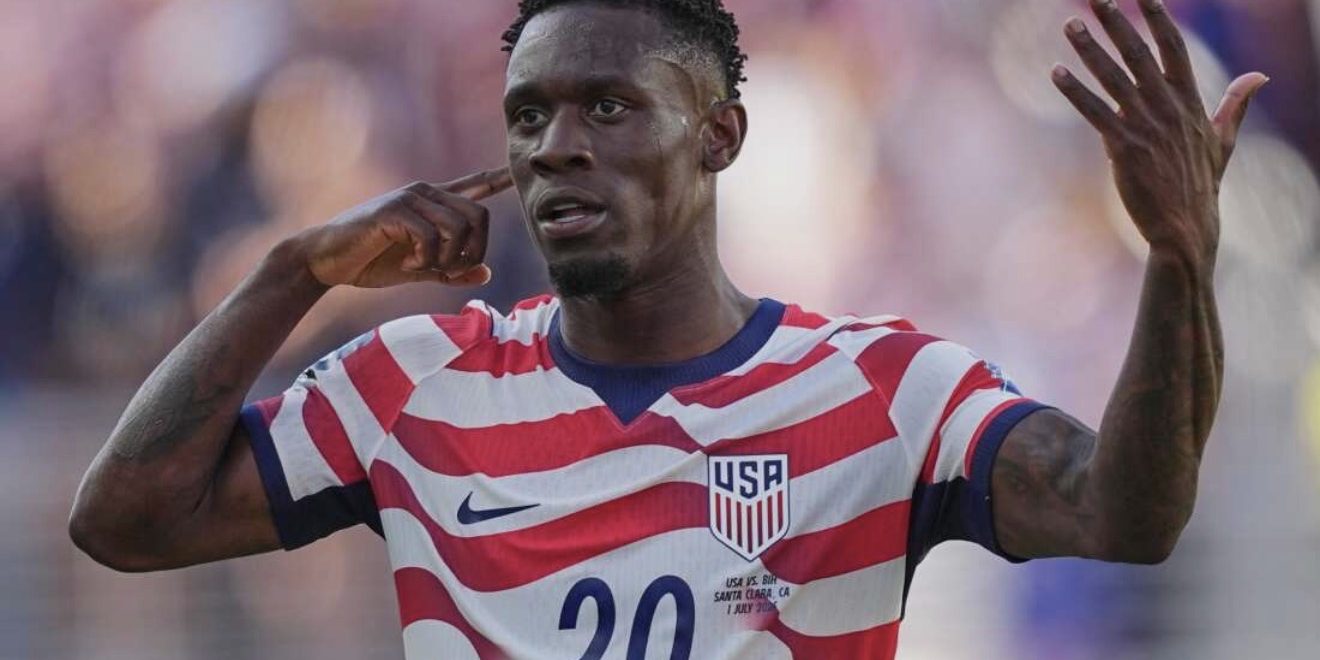

Table of Contents
Folarin Balogun will line up for the United States against Belgium in Monday’s World Cup round of 16 in Seattle, after FIFA suspended his one-game red card ban in a ruling that immediately became one of the most discussed decisions of the tournament.
The announcement came on Sunday, just over 24 hours before kick-off, ending days of uncertainty that had threatened to rob the American hosts of their leading scorer at the worst possible moment.
FIFA’s Disciplinary Committee invoked Article 27 of its Disciplinary Code, a provision that allows it to suspend the enforcement of a sanction and impose a probationary period in its place.
“The implementation of the match suspension is suspended for a probationary period of one year,” FIFA announced. “If Folarin Balogun commits another infringement of a similar nature and gravity during the probationary period, the suspension shall be revoked and the sanction enforced without prejudice to any additional sanction imposed for the new infringement.”
For a United States team built around Balogun’s movement and clinical finishing, the ruling changed everything. He has scored three goals in the tournament and is the focal point of Mauricio Pochettino’s attack. His absence would have forced wholesale changes to a system that has looked increasingly sharp with each passing game.
The Incident and the Red Card
Balogun was sent off in the 64th minute of the Americans’ 2-0 round of 32 victory over Bosnia and Herzegovina. The challenge itself was brief: his foot made contact with the ankle of Bosnian defender Tarik Muharemović. Referee Raphael Claus of Brazil did not show a card on the field. The video assistant referee flagged the incident and directed Claus to review it at the pitchside monitor; after examining slow-motion footage, Claus issued the red card.
The charge was serious foul play. To many watching in real time, the contact appeared accidental. Balogun was not challenging aggressively for the ball, and the nature of the incident seemed to fall short of the standard that classification typically requires.
In the days that followed, Balogun’s response was measured. “Would have been fair,” he said of a yellow card. “It’s something that’s happened, so we have to move forward and I have to accept it.”
He did not dwell publicly on the situation, instead posting a picture of himself surrounded by US fans on social media, set to the sound of Michael Jackson’s “Bad.” The post was a signal that he had processed the setback and moved on.
The History He Is Chasing
Balogun’s three goals at this World Cup have placed him alongside Landon Donovan’s total from the 2010 tournament in South Africa. He now stands second on the all-time list of American scorers in a single World Cup edition. Only Bert Patenaude, who scored four times in the inaugural tournament in Uruguay in 1930, has scored more for the United States in a single World Cup.
That record reflects how much Balogun has changed what America can expect from a center-forward at a major tournament. For years after the eras of Jozy Altidore and Brian McBride, the United States had struggled to find a striker who could consistently score at the highest level of international football. Balogun arrived in 2023 and has steadily become that player.
The Path to an American Jersey
Born in New York to Nigerian parents who had traveled from their home in London, with his mother unable to fly back before his birth, Balogun grew up in England and came through Arsenal’s academy alongside Bukayo Saka, Emile Smith Rowe and Eddie Nketiah at Hale End. He represented England up to under-21 level.
A loan spell at Reims in Ligue 1 produced 21 goals in 37 appearances and announced him as a striker of real ability. In the summer of 2023, Monaco paid Arsenal £35 million for his permanent signature. That same summer, in May 2023, Balogun traveled to Orlando for a series of meetings with US Soccer officials.
A photograph of him in the United States circulated widely. His Instagram account was flooded with messages from American fans. One morning at breakfast, a father and his young son approached him to express what it would mean if he chose the Stars and Stripes. He made the choice.
His first competitive goal for the United States came in the CONCACAF Nations League final victory over Canada in 2023. With a World Cup on home soil four months away when he first pulled on the shirt, the target was always clear.
The Form That Built to This Moment
Balogun’s 2024/25 Monaco season was disrupted by injury, but the final stretch of the campaign told a different story. He scored in eight consecutive league matches and collected 11 goals in 14 appearances to close out the season. Two of those goals came in the Champions League against Paris Saint-Germain. He added a goal against Senegal in a pre-World Cup friendly and arrived at this tournament in the best form of his career.
Pochettino is believed to have flown to meet Balogun personally when he accepted the USMNT head coaching role in 2024, making him among the very first players he visited. The understanding between manager and forward has been central to how the team has set up, with Balogun given the freedom to press, run in behind, and finish in the areas where he is most dangerous.
Peter Smith, writing for Sky Sports, described Balogun as “a player who welcomes the pressure rather than runs from it” and one who “prepares well and uses that to deliver ice-cold performances on the pitch.” Those performances have earned him a squad captained by Christian Pulisic but built, in many ways, around what Balogun does best.
A Nation and a President React
The FIFA ruling prompted a response from the highest level of American public life. President Donald Trump posted on social media to praise the decision.
“Thank you to FIFA for doing what was right, and reversing a great injustice!” Trump wrote.
That the American head of state reacted publicly within hours of FIFA’s announcement reflects how far Balogun’s situation had moved beyond sport. For a country that embraced soccer through the 1994 World Cup and has been building toward this hosting moment from that point on, the stakes in Seattle on Monday are significant.
The United States is targeting the quarterfinals for the first time in more than two decades. The Americans last reached that stage in 2002. In the years that followed, they fell in the round of 16 to Ghana in 2010, Belgium in 2014, and the Netherlands in 2022. They did not advance from the group stage in 2006 and missed the 2018 tournament in Russia entirely.
Monday’s match carries particular weight. Belgium are the team that ended the American run in Brazil in 2014 with a 2-1 extra-time win in Salvador. The players in Seattle know that history. Some watched it as teenagers. All of them know what it would mean to go further this time.
US Soccer confirmed on Sunday that Balogun would not be made available to speak with media ahead of the match. His social media post had already communicated what needed to be said. He will play. The ban is lifted. And the United States have their striker back for the night that could define this generation of American soccer.

Leave a Comment
More in News

Moise Kean Will Miss Como’s Biggest Game of the Season After Cesc Fabregas Clashed With Italy’s Doctors
Oliver Glasner Returned to Crystal Palace and Fans Turned From Applause to Taunts as Forest Lost
Vinicius Red Card for Hair Pull Leaves Mourinho Snubbing the Press
Bowen’s Saved Penalty Costs West Ham a Shot at Top Spot

Cole Palmer Missed England’s World Cup Squad This Summer, and His Club Have Just Backed Him With a Deal Running to 2034
Trending on Futbol Chronicle
What Is Offsides in Soccer? The Offside Rule Fully Explained
Arab football federations back Gianni Infantino as FIFA president faces growing opposition
Josef Martinez Returns to MLS Spotlight With Columbus Crew Signing
Michael Carrick admits Manchester United have “no excuses” after AC Milan defeat