England Have One Game Left to Top Group L and Shape Their World Cup Route
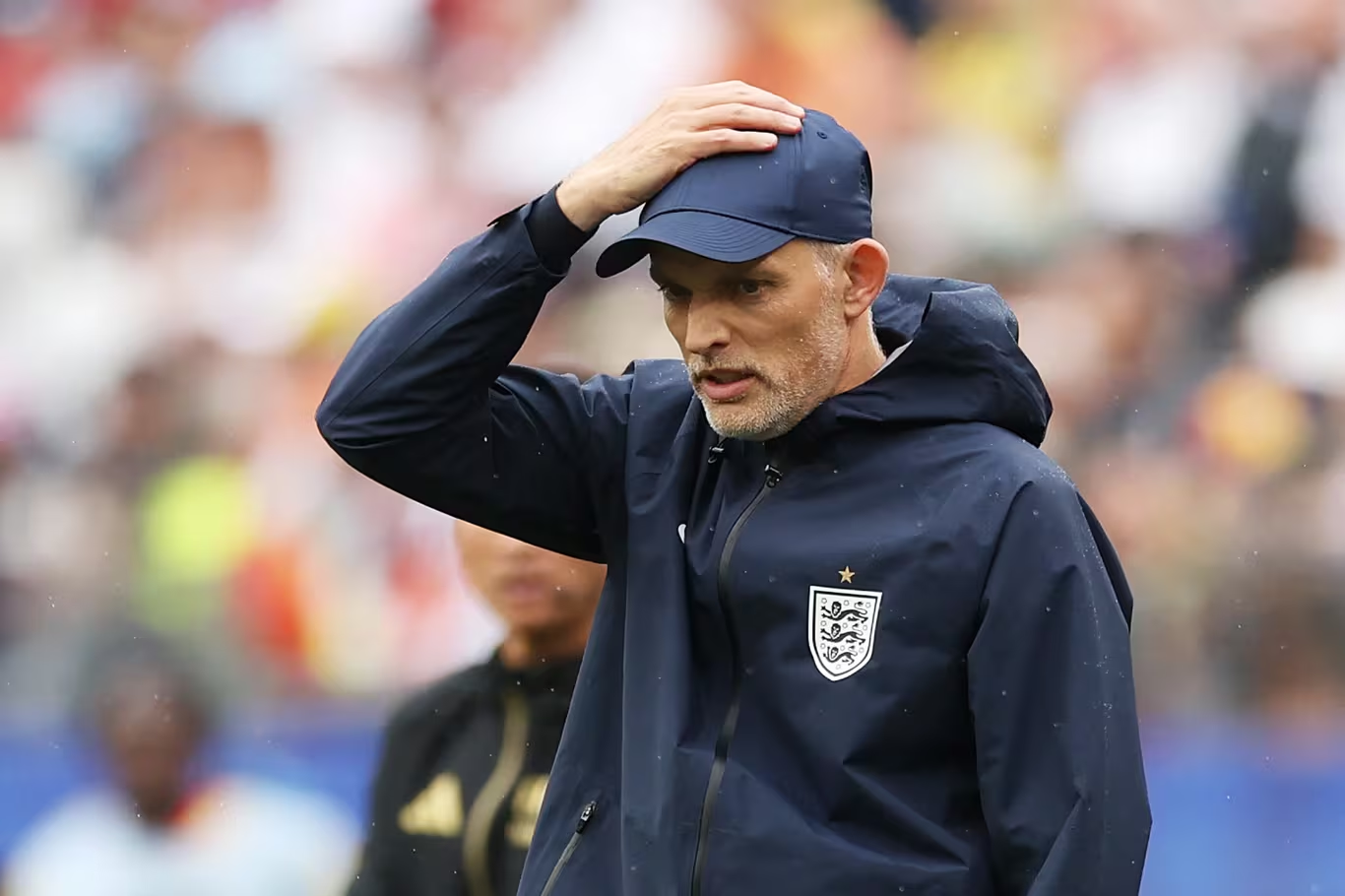
Table of Contents
England arrived in North America promising something different, and two matches in they have delivered exactly the kind of football that splits a nation in half. A 4-2 win over Croatia in Arlington announced them as one of the tournament’s most watchable sides. A goalless draw with Ghana three days later reminded everyone that a World Cup rarely runs in a straight line. Now Thomas Tuchel takes his squad into the final Group L fixture against Panama on 27 June with the arithmetic almost settled and the interesting questions only just starting.
Four points from two games has left England in firm control of their group without quite slamming the door shut. Top spot, and the knockout route that comes attached to it, will be decided in New Jersey against a Panama side already eliminated and playing only for pride. For Tuchel, the German hired to end six decades of English waiting, this last group game is not about survival. It is about selection. And the calls a manager makes in a dead rubber often reveal more about how he is thinking than any comfortable victory ever could.
A goalless draw that asked more questions than it answered
The Ghana game was the sort of night that tells you who a team really is. England controlled long stretches of possession, created the better openings and still could not break through a disciplined, deep-lying Ghana block organised by the vastly experienced Carlos Queiroz. Harry Kane spurned a late chance that on another evening he buries without thinking. The frustration spilled over at the interval, with reports of a heated exchange involving Jude Bellingham that Tuchel later moved quickly to play down.
For all the irritation, there was something underneath the result worth holding onto. England have not conceded a goal in open play across their two matches, and only a handful of teams arrived at the knockout reckoning with a meaner defensive record. Tournaments are not won by the side that entertains in June. They are won by the side still standing in July, and clean sheets travel further than highlight reels. The draw delayed automatic confirmation of top spot, but it did little to dent the sense that this England team is built to grind through the kind of tight, low-scoring knockout tie that has so often ended their summers early.
Why finishing first in Group L is worth far more than pride
It would be easy to dismiss the Panama match as a formality. It is anything but, because of what hangs on the final standings. The winner of Group L is rewarded with a Round of 32 tie in Atlanta on 1 July against one of the best third-placed qualifiers drawn from groups E, H, I, J or K. That is, on paper, the softest landing available to a group winner and the gentlest possible start to a knockout campaign.
Slip to second, and the picture darkens considerably. A runner-up finish points towards a meeting with the runner-up from Group K, most likely Portugal, in Toronto, and a far more punishing half of the bracket. The reward for topping the group is not merely an easier first opponent. It is a kinder path that keeps the heavyweight collisions with Brazil and Argentina as late as possible, ideally at the business end where England would back themselves to be fresh and ready. A possible Round of 16 trip to Mexico City and the altitude of the rebuilt Azteca looms as one of the tournament’s trickiest assignments, the kind of fixture that can quietly undo a favourite. Every place in the table England gains now shapes the obstacles waiting weeks down the line.
The rotation call Tuchel actually wanted
Here is the part that should excite England supporters. For once, an England manager arrives at a final group game with the freedom to choose rather than the obligation to chase. The points are effectively banked. Panama have nothing to play for beyond denying England top spot. That combination hands Tuchel the luxury that so many of his predecessors lacked: the chance to manage a match for what comes after it.
Expect that freedom to show. Players carrying a yellow card will be protected from the suspension that a second booking would bring into the knockouts. Senior names such as Kane and Bellingham can be given a breather, or a reduced shift, with the summer heat of the eastern seaboard a genuine factor in how England plan their minutes. Fringe players who have watched from the bench get a window to stake a claim and to show they can be trusted when the games turn unforgiving. Tuchel has spent his managerial life as a tactician obsessed with detail, and a dead rubber is precisely the canvas a coach like him relishes. The depth of this squad, deeper than England have carried to a major tournament in years, means he can rest and rotate without surrendering quality.
Contrast that with the recent past. England managers have repeatedly stumbled into the knockouts with tired legs and thin options, forced to play their strongest eleven into the ground because the alternatives did not inspire confidence. Tuchel does not have that problem. The names left out of his first-choice side would walk into most other squads at this World Cup, and the Panama game is his chance to prove it without risking anything of consequence.
Six decades of hurt and a German hired to end it
None of this can be separated from the weight England carry. It has been sixty years since 1966, six decades of near misses, penalty heartbreak and the same questions asked every two years. The decision to appoint Tuchel, the first German to manage the England men’s team, was a statement in itself: that the Football Association wanted a serial winner who had lifted a Champions League and league titles, a coach unburdened by the emotional scar tissue that has weighed on English football for generations.
Tuchel’s pragmatism is exactly what these knockout rounds demand. He is unsentimental about reputations, ruthless about roles and clear that results come before romance. Leaving a player of Phil Foden’s pedigree out of the squad entirely was an early signal that he would pick for balance, not for headlines. The Panama game offers another small window into that mind: who he protects, who he trusts, and how he wants England to look when the margin for error disappears.
What it means for the wider tournament
England’s situation is a neat illustration of how the expanded 48-team World Cup reshapes the group stage. With eight of the best third-placed teams advancing, the cost of a single dropped result is no longer elimination but seeding, and seeding is everything in a bracket this large. The teams who treat their final group game seriously, who chase the right finishing position rather than easing off, will hand themselves a measurably smoother route. Those who coast may find themselves on a collision course with a giant far too early.
There is also the backdrop of playing a World Cup on North American soil, where the diaspora crowds have turned almost every fixture into something resembling a home game for somebody. England have felt the noise, the heat and the travel, and the knockout rounds will test their ability to handle all three at once. Topping the group does not remove those challenges, but it softens them, and in a tournament this long the accumulation of small advantages is what separates the teams that go deep from the teams that go home.
The last group game that is really the first knockout game
So England go to New Jersey not to qualify, in all likelihood, but to set the terms of everything that follows. Beat Panama and top the group, and the reward is a kinder opponent, a kinder route and a squad rotated just enough to arrive at the knockouts with fresh legs and clear heads. It is the position every manager wants and almost none get: a competitive game with the pressure removed and the future to play for.
For all the noise around the Ghana draw, this is a team in a strong place, carrying the best defensive platform England have taken into a knockout round in years and a manager who has waited his whole career for a summer like this one. The hard part starts on 1 July. The Panama game is where Tuchel quietly decides how ready his England will be when it does.
The opponent with nothing left but a spoiler’s role
It would be a mistake to think Panama will simply roll over. Thomas Christiansen’s side arrive bottom of the group, eliminated and without a goal to their name, but a tournament exit can be a liberating thing. With no pressure and nothing to lose, Panama can throw themselves at England in a way they could not against Croatia, where caution cost them. For Christiansen, the Danish-Spanish coach who has spent years dragging Panamanian football towards respectability, denting one of the favourites would be a result his players carry home with pride.
That is exactly why Tuchel cannot afford to treat the night as a kickabout. A rotated England side still needs to win convincingly enough to guarantee top spot and avoid the kind of scrappy, momentum-sapping performance that can linger into a knockout campaign. The balance Tuchel must strike is delicate: rest the bodies that need resting, protect the players a booking away from suspension, and still send a message that England intend to control their own destiny rather than back into the next round. Get that balance right against a motivated underdog, and England walk into the knockouts with the route they want and the rhythm they need.
For a squad chasing a first World Cup in sixty years, those are the fine margins that decide everything. Panama will play their final match of the tournament with freedom. England will play theirs with a plan. The difference between the two mindsets is the difference between a team that has arrived to enjoy the World Cup and a team that has arrived to win it.

Leave a Comment
More in News

Trent Alexander-Arnold Returns to the England Squad for the First Time in Over a Year, and Cole Palmer Is Back Too After Their World Cup Snub

Gabriel’s Boot Caught Emiliano Martinez in the Head, and a Five-Person Premier League Panel Ruled It Was Never a Red Card

Floyd Samba Scores a Debut Double as a Teenager

Tottenham Spent £300m This Summer and Have Not Scored in Four Premier League Games for the First Time in the Club’s 144-Year History

Cyle Larin Scored Once in 15 Games on a Failed Feyenoord Loan, and Is Now Outscoring Kylian Mbappe and Erling Haaland at Southampton
Trending on Futbol Chronicle
Map of All the Premier League Teams for 2025/26
Arab football federations back Gianni Infantino as FIFA president faces growing opposition
Michael Carrick points to lack of sharpness after Manchester United draw with West Ham
Michael Carrick admits Manchester United have “no excuses” after AC Milan defeat