Harry Kane Stands One Goal From Gary Lineker’s England World Cup Record
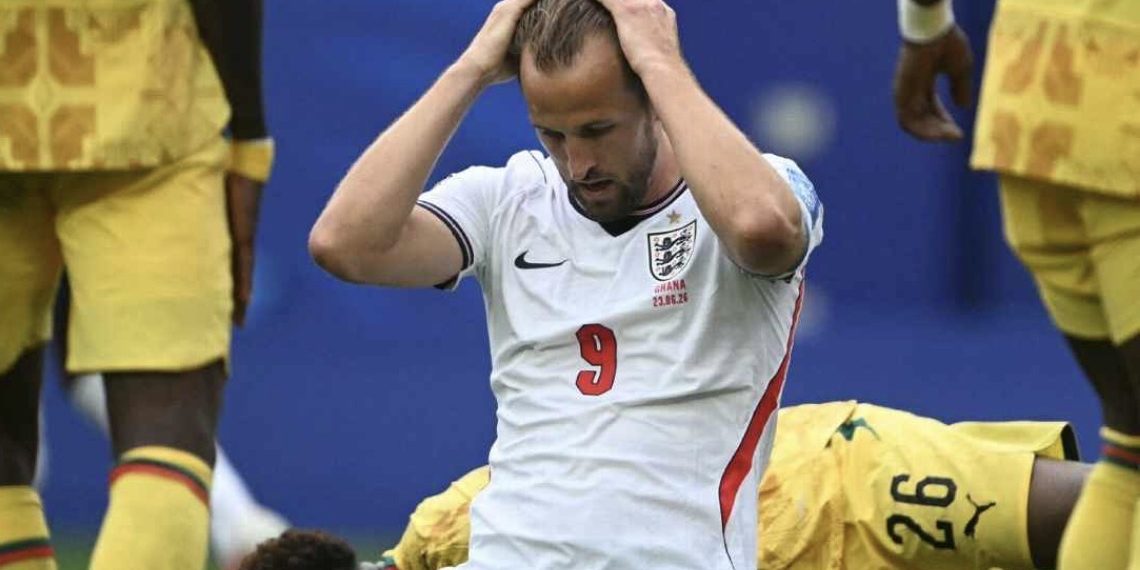

Table of Contents
Forty years ago a moustachioed striker from Leicester scored six goals at a World Cup in Mexico, won the Golden Boot, and set a mark that no England player would touch for four decades. Gary Lineker finished his international career with ten World Cup goals, a number that sat untouched through Alan Shearer, through Michael Owen, through Wayne Rooney. Then Harry Kane lashed in a penalty against Croatia in New Jersey on 17 June, added a second from open play, and pulled level with the man who now reads out the football scores on a Saturday night. One more goal and the record belongs to Kane alone.
The chance arrives on Saturday against Panama at MetLife Stadium, England’s final Group L fixture. Kane has scored against worse sides, and he has scored against this exact one. The last time the two met at a World Cup, in Nizhny Novgorod in 2018, he walked off with the match ball after a hat-trick in a 6-1 win. Eight years on, the captain stands one goal from history and a tournament from the only prize that has eluded him.
The number Lineker never expected to lose
Lineker has spoken warmly about Kane for years, and he has been honest about the record too. He held it for a long time precisely because scoring at World Cups is hard. A player needs longevity, fitness across multiple summers, and the small fortune of his country qualifying again and again. Lineker managed his ten across two tournaments, six in 1986 and four in 1990, before a third in 1994 never came because England failed to reach it.
Kane has done it across three. He scored six in Russia in 2018, the haul that won him the Golden Boot, two in Qatar in 2022, and now two more in 2026. That makes him the second England player to score at three separate World Cups, and the consistency tells its own story. His tournament rate sits at 0.72 goals per game, a figure that would have most strikers in history checking the maths twice. For a man who is sometimes painted as a penalty-box poacher, the spread is striking: tap-ins, headers, long-range strikes, and the cool from twelve yards that has become his signature.
The penalty record nobody talks about
That cool deserves its own paragraph. Kane’s opener against Croatia was his fifth World Cup penalty, which is more than any player has converted in the tournament’s history. Spot kicks carry a particular weight at a World Cup because the cameras zoom in, the stadium holds its breath, and a miss follows a man for years. Kane has stood over five of them on the biggest stage and beaten the goalkeeper every time.
He knows the alternative. Roberto Baggio knows it. Stuart Pearce knew it for six years until he buried one against Spain at Euro 96 and roared the demons out of himself. Kane’s penalty record is not luck. It is a routine built on repetition, on the same run-up and the same side until a goalkeeper guesses right and even then often fails to reach it. The Bayern Munich striker has turned the most pressured kick in football into something close to a formality, and at a tournament decided by fine margins that reliability could carry England a long way.
A captain still chasing the one thing missing
Kane has won almost everything a forward can win at club level. He broke Tottenham’s all-time scoring record, then moved to Bayern Munich and ended a long personal wait for a major trophy by lifting the Bundesliga. He has scored at a rate that puts him among the best the European game has produced this century. What he does not have is an international trophy, and at 32 the runway is shortening.
England reached the final of Euro 2024 and lost to Spain, the second European final in a row that ended in heartbreak. Kane captained the side through both. The criticism that follows him at tournaments tends to circle the same point, that he goes quiet in the biggest games, and the 0-0 draw with Ghana on 23 June gave the doubters fresh material. He had chances. He did not take them. Thomas Tuchel kept faith afterwards, pointing out that a striker who has equalled Lineker’s record does not suddenly forget how to finish.
There is a human edge to the chase that the statistics miss. Kane grew up a Tottenham fan in Chingford, was released by Arsenal as a boy, and spent his early twenties on loan at Leyton Orient, Millwall, Norwich and Leicester before anyone took him seriously as a top-flight striker. The record he is about to break belongs to a man whose face he watched on television as a child. Breaking it would be a quiet kind of full circle.
Panama, and the route that opens up
Panama offer a familiar test. They sat deep against England in 2018 and were picked apart, and there is little to suggest this version of the side has the tools to contain Kane and the attackers around him. England can still top Group L with a win, which shapes the knockout route in front of them. Finish first and the round of 32 brings a third-placed qualifier; slip to second and the draw points toward Portugal, Colombia or DR Congo from a tougher Group K.
Tuchel has a selection question to answer too. England’s forwards have not flowed in the way the talent suggests they should, and the German has rotated his front line looking for the right combination. Kane is the one fixed point. Whatever shape the team takes around him, the captain leads the line, and the record is now a goal away rather than a tournament away.
Should it fall against Panama, the symmetry would be hard to ignore. The same opponent that gave him a hat-trick in 2018 would hand him the outright England World Cup scoring record in 2026. From there the focus shifts back to the only target that has ever mattered to him, the trophy, and the knowledge that no England striker has ever been better placed to chase it.
The forwards who never got there
To understand why ten World Cup goals took forty years to equal, look at the strikers who fell short. Alan Shearer, England’s record Premier League scorer, managed only two at World Cups across an injury-disrupted international career. Michael Owen, who announced himself to the planet with that goal against Argentina as an 18-year-old in 1998, finished with four. Wayne Rooney, England’s all-time leading scorer for a decade, never matched his club brilliance on this stage and ended with a single World Cup goal. Each was a forward of genuine pedigree. None got close to Lineker.
The reasons vary, but a pattern emerges. World Cup goals require a player to peak in a specific four-week window every four years, while fit, while his country qualifies, against defences built to stop exactly him. Owen’s body broke down. Rooney’s tournaments rarely aligned with his best club form. Shearer’s international career was cut short. Kane has avoided every one of those traps. He has arrived at three straight World Cups in form, fit, and trusted to lead the line, and he has scored at all three. The longevity is the achievement as much as the finishing.
His club season fed straight into this. Kane spent the campaign scoring at his usual relentless clip for Bayern Munich, the goals piling up in the Bundesliga and Champions League until a summer tournament felt like an extension of his day job rather than a step up. A striker who carries that rhythm into a World Cup is a different proposition from one trying to rediscover it on the fly. Kane crossed the Atlantic mid-flow, and the brace against Croatia was the proof.
Why the record carries weight
Records like this one are not just trivia. They mark out the players who turn up when it counts, summer after summer, against the best opposition the planet can assemble. Lineker’s ten stood for forty years because the bar is set so high. Kane reaching it across three tournaments, while also holding the penalty record and pushing his goals-per-game rate above anything England have produced, places him in a conversation with the country’s finest forwards and arguably above them.
The wider point for England is what it signals about their attacking core heading into the knockouts. A captain in form, comfortable on the biggest stage, with a habit of scoring when the stadium tightens, is the kind of asset that wins tournaments rather than merely reaches finals. England have done the reaching. Twice in two years they have stood a game from glory and fallen short.
Kane’s chase is a reminder that the individual brilliance has rarely been the problem. He has scored at three World Cups and is about to stand alone at the top of the list. The question that has shadowed his career is whether the team around him can match the standard he sets. Against Panama he can answer the first half of that question with a single swing of his boot. The second half, the one he cares about most, waits in the rounds beyond.

Leave a Comment
More in News

Thierno Barry Was Filmed Crying In A Private Training Session Last Season, And He Has Already Scored In Three Games This Campaign

Gravenberch’s Red Card Sparks Referee Row in Liverpool’s Defeat to City

Moise Kean Will Miss Como’s Biggest Game of the Season After Cesc Fabregas Clashed With Italy’s Doctors
Oliver Glasner Returned to Crystal Palace and Fans Turned From Applause to Taunts as Forest Lost
Vinicius Red Card for Hair Pull Leaves Mourinho Snubbing the Press
Trending on Futbol Chronicle

Josef Martinez Returns to MLS Spotlight With Columbus Crew Signing

What Is The Club World Cup?
Celta Vigo postpones LaLiga opener after fungus outbreak damages stadium pitch
Michael Carrick points to lack of sharpness after Manchester United draw with West Ham