Ivan Toney Served a Gambling Ban and Fought His Way Back Into England’s Squad
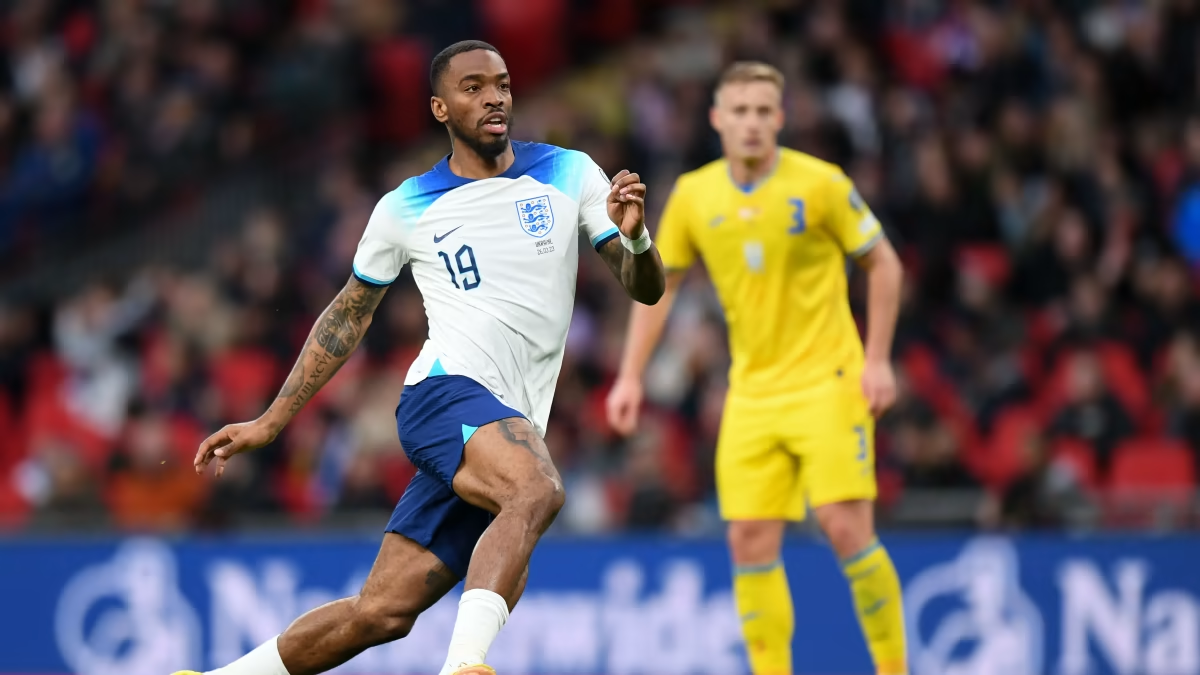
Table of Contents
Ivan Toney admitted to 232 breaches of the Football Association’s betting rules. Some of them involved wagering against his own team. The punishment, an eight-month suspension, looked at the time like the end of a serious international career before it had properly started. Toney was 27, banned, and watching the game he loved from the outside. Three years later his name sits on Thomas Tuchel’s England squad list for the 2026 World Cup, and the path between those two points is one of the strangest redemption stories in the tournament.
Most players never come back from a scandal that includes betting against your own side. The trust, once broken, tends to stay broken. Yet Toney scored on his first game back, forced his way into an England squad for the European Championship within months, played a part in two knockout ties at that tournament, then left English football altogether for Saudi Arabia, where he has scored at a rate that made it impossible for England to keep ignoring him. He has done what almost nobody manages, which is to turn the lowest point of a career into the foundation of its second act.
The ban that should have finished him
The charges were extensive. Toney was found to have committed 232 breaches of betting rules over a period stretching back years, a number large enough that no amount of context could make it small. The most damaging detail was that some of the bets were placed against teams he was playing for, the single act that strikes at the heart of why footballers are forbidden from gambling on the sport at all. When the case concluded, Toney was suspended for eight months and fined.
There was a mitigating thread, and it is an important one. During the process Toney was formally diagnosed with a gambling addiction. The independent commission reduced his suspension partly on those grounds, accepting that his behaviour was driven by a recognised condition rather than simple cynicism. Toney himself was bruised by the experience and described aspects of the FA’s handling as harsh. The diagnosis did not excuse the breaches, but it reframed them, turning a story about a cheating footballer into a more uncomfortable one about a young man with a problem that the sport’s gambling-saturated culture had done nothing to help.
That distinction shapes how the comeback is understood. Toney did not simply serve a ban and carry on as before. He came back having confronted something, and the version of him that returned was a more serious professional than the one who left.
Brentford, the goal, and the surprise call
He returned to Brentford in January 2024 and scored on his comeback, the kind of immediate statement that tends to silence the doubters in the stands if not the ones in the columns. By the summer of 2024 he had done something almost nobody predicted during the dark months of his suspension. Gareth Southgate named him in the England squad for the European Championship in Germany.
What followed at that tournament gave Toney his folk-hero moment. In the round of 16 against Slovakia, with England staring at an embarrassing early exit, Toney came off the bench and produced a piece of audacious improvisation, flicking the ball with the outside of his boot into the path of Harry Kane for the extra-time winner. He never broke stride and never looked at the ball. Then in the quarter-final shootout against Switzerland, he stepped up and buried his penalty without so much as a glance at the goalkeeper, the coldest of finishes from a man who eight months earlier had been banned from the sport. England reached the final. Toney had gone from outcast to one of the most reliable nerves in the squad.
That penalty deserves a second look, because it told you everything about the temperament Toney had built in exile. England’s history with shootouts is a national trauma, a catalogue of hesitant run-ups and saved spot-kicks stretching back decades. Toney walked up as if he were taking a training-ground drill, placed the ball, and dispatched it without ever looking at Yann Sommer, one of the best goalkeepers in the world. Sports psychologists call it an externally focused routine, a method of blocking out the goalkeeper entirely. For a man who had spent months in the wilderness wondering whether he would ever play for his country, the calm was almost unnerving. It was the moment England realised that whatever Toney had been through, it had left him hardened rather than broken.
The Saudi gamble that paid off
What he did next divided opinion. In August 2024, at 28 and with his stock as high as it had been in years, Toney left the Premier League for Al-Ahli in the Saudi Pro League for a reported 40 million pounds. The conventional wisdom held that a move to Saudi Arabia was where ambitious international careers went to fade, that managers would forget about players out of sight in a less scrutinised league. For most, that has been the pattern. Jordan Henderson’s England career did not survive his Saudi spell. Toney bet that he could be the exception.
He has been. Toney has scored at a goal-per-game pace for Al-Ahli, hitting 32 goals in as many league appearances in a recent season, numbers so emphatic that they could not be dismissed as flat-track padding. When Tuchel sat down to pick his 2026 World Cup squad, the case for Toney was not sentimental. It was statistical. A striker scoring a goal a game, with proven tournament temperament and a penalty record that England have long craved, is exactly the kind of insurance a manager wants behind Harry Kane. The move that was supposed to end his international hopes instead kept them alive.
What he gives this England team
Toney is not in the United States to start ahead of Kane. He is there because of what he offers when the game is tight and the bench needs a player who does not flinch. England have spent years searching for a reliable second striker, a different profile to bring on when a match needs forcing open or closing down. Toney is a target man with genuine quality, a player who can hold the ball up, bring others into play, and finish from the penalty spot when a shootout looms. In a tournament that so often comes down to penalties, England now carry a man who has already shown he will take and score one on the biggest stage without visible nerves.
There is a leadership element too. A dressing room that contains a player who has been to the bottom and climbed back has a resource that pure talent cannot provide. Younger squad members watching Toney can see, in one career, both a cautionary tale about gambling and a model for how to respond when everything appears lost. He carries the rare authority of someone who has nothing left to prove about his resilience.
His Saudi form should not be dismissed as easily as some in England would like, either. The Saudi Pro League has spent heavily to import elite talent, and the defenders Toney scores against now include former Champions League regulars and seasoned internationals. A goal-per-game return in any competitive league is the mark of a striker in genuine form, and Toney has sustained it across a full season rather than a hot run. Tuchel, a coach who built his reputation on cold analysis rather than reputation or sentiment, clearly studied the numbers and concluded that a striker scoring this freely could not be left at home simply because he plays his football outside Europe. In doing so, he made a quiet statement about how the modern game evaluates players regardless of where they ply their trade.
A story bigger than football
Toney’s path also lands in the middle of an uncomfortable conversation the English game has been avoiding for years. Football in England is awash with gambling money, from shirt sponsors to the advertising hoardings to the relentless in-play betting promoted around every fixture. Players are forbidden from gambling on the sport while being marinated in its messaging from the moment they turn professional. Toney’s addiction did not appear in a vacuum. It grew inside a culture that profits from the very behaviour it punishes its players for.
None of that erases the 232 breaches or the bets against his own teams. Those were real, and the punishment was deserved. But the fuller story is more honest and more human than a simple morality tale. A young man with an addiction broke the rules, was caught, faced the consequences, got help, and rebuilt. That he has rebuilt all the way to a World Cup squad is remarkable. When Toney warms up on the touchline in the United States, ready to come on and change a game, he does so as living proof that a career can survive its worst chapter, provided the player is willing to confront what put him there.

Leave a Comment
More in News
Bowen’s Saved Penalty Costs West Ham a Shot at Top Spot

Cole Palmer Missed England’s World Cup Squad This Summer, and His Club Have Just Backed Him With a Deal Running to 2034
Enzo Maresca Insists Manchester City’s Titles Are Not Tainted After the Club Was Found Guilty on 115 Charges
Michael Carrick Lost Two Title Races to Manchester City, and United Fans Now Mark 50 Years Without a Trophy

Jarell Quansah Was Never Liverpool’s Top Academy Prospect, and He Has Already Won Eight England Caps
Trending on Futbol Chronicle

What Is The Club World Cup?
The Best Soccer Players of All Time: The 10 Greatest Ever Ranked
Michael Carrick points to lack of sharpness after Manchester United draw with West Ham
Cristian Romero completes €40m move from Tottenham to Atlético Madrid