Ivan Toney Was Banned for Betting and Exiled to Saudi Arabia Before England Called Again
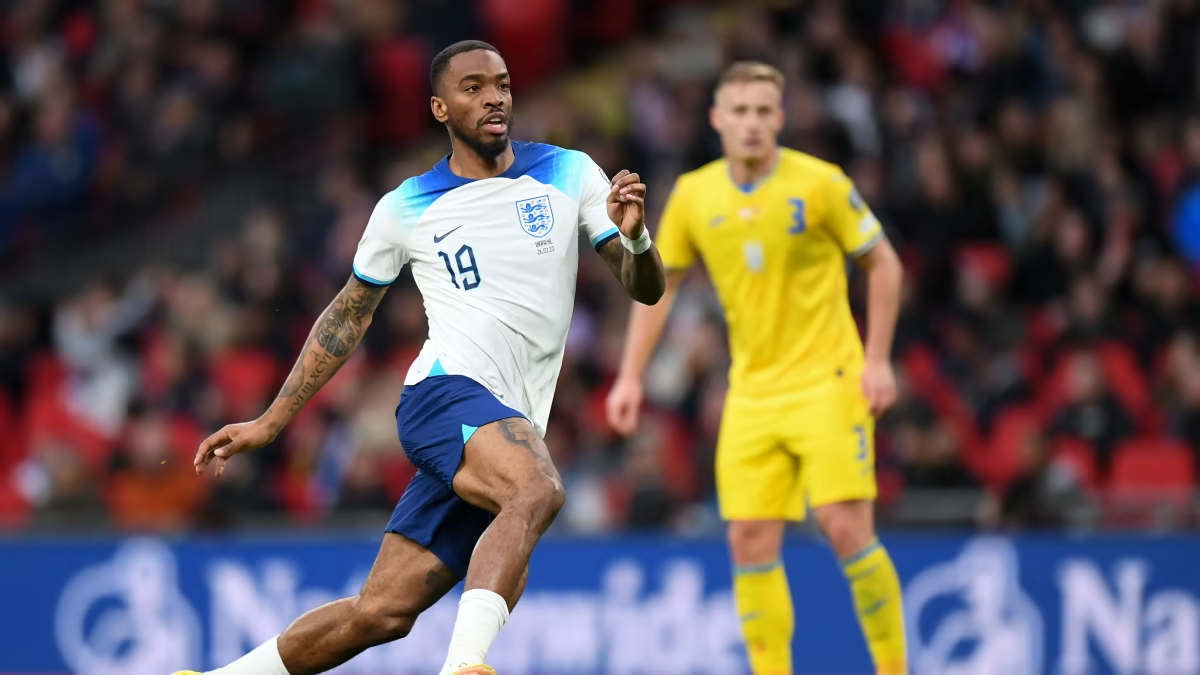
Table of Contents
In May 2023, Ivan Toney sat in a hearing that could have ended his football career. The Football Association had charged him with 232 separate breaches of its betting rules, some of them wagers placed on matches involving his own teams. He was handed an eight month suspension and a fine of fifty thousand pounds. He was thirty years old, coming off a twenty goal season for Brentford, and suddenly he was a striker with no club to train with and a reputation in pieces. Three years later, his name sits on Thomas Tuchel’s England squad list for the 2026 World Cup. The distance between those two moments is one of the strangest stories any player will carry into this tournament.
It would have been easy to write Toney off. Plenty did. A betting ban for a footballer is not just a punishment, it is a stain that follows you into every interview and every team selection debate. That he has come out the other side, scoring at close to a goal a game in a league most English fans never watch, and forced his way back into the national reckoning, says something about a player who has spent his entire life being underestimated.
The Ban That Could Have Finished Him
The detail of the charges made the case difficult to defend. Toney admitted to 232 rule breaks. Some involved betting against his own team, a fact that cut deep with supporters who had watched him lead the line. An independent commission settled on an eight month ban, reduced from a longer term after a gambling addiction was taken into account by the panel. He paid the fine. He stayed away.
What he did with that time told you plenty. Rather than disappear, Toney trained alone, worked on his fitness, and spoke openly about the addiction that sat behind the charges. He has since described the FA process as harsh in tone, telling interviewers that the way the ban was handled felt designed to make an example of him rather than to help. Whatever the rights and wrongs of that view, he served the suspension, returned to Brentford in January 2024, and scored on his comeback as if the gap had never existed.
By the summer of 2024 he was in Gareth Southgate’s England squad for the European Championship in Germany. He did not start, but he made himself useful. In the round of sixteen against Slovakia, with England staring at the exit, Toney came on and flicked the ball into the path of Harry Kane for the extra time winner that followed Jude Bellingham’s last gasp equaliser. In the quarter final shootout against Switzerland, he stepped up and buried his penalty without so much as a glance at the goalkeeper. For a player so recently cast out, those were loud statements made in quiet moments.
The Saudi Gamble Nobody Expected
Then came the move that should, by conventional wisdom, have ended his international career. In August 2024, Brentford accepted a large fee from Al Ahli and Toney left the Premier League for the Saudi Pro League. The accepted logic in English football is simple. Leave for Saudi Arabia and you leave the national team behind, because nobody is watching and the standard is questioned. Jordan Henderson had gone and come back. Others had not been so lucky.
Toney never seemed to believe the warnings applied to him. He has said since that he never feared the move would cost him his England place, because a striker is judged on goals and goals travel. The numbers have backed the bravado. Across two seasons in Saudi Arabia he has scored 72 goals in 93 appearances. This past campaign he managed 32 goals in 32 league matches, a strike rate that would draw attention in any competition on earth.
The question that hung over his selection was whether those goals counted. Tuchel decided they did. When the German named his 26 for the World Cup in May, Toney was on the list and Harry Maguire, a fixture of England squads for the better part of a decade, was not. Cole Palmer, one of the most gifted attacking players in the Premier League, also missed out. The Athletic’s Jay Harris called Toney’s inclusion a huge shock, noting that the striker had not featured for England under Tuchel since a brief cameo in the defeat to Senegal in June 2025.
Why Tuchel Wanted Him
So what does Tuchel see? The clearest reading is that he wanted a different kind of striker to hold in reserve. England are well stocked with movement and pace in the final third. What they have lacked in tournaments is a physical presence who can be thrown on to change the shape of a game, to occupy centre backs, to win the duels that decide tight knockout matches in the final twenty minutes. Toney is that player. Harris described him as a wildcard Tuchel can pull in emergency circumstances, and the phrase fits.
There is also the matter of temperament. Toney’s penalty technique, where he decides his corner in advance and refuses to react to the goalkeeper, has become almost a study in nerve. In a tournament that can turn on a shootout, a manager wants men who have already proved they will not blink. England’s painful history from twelve yards is well documented. Toney offers an antidote to it.
None of this guarantees him minutes. He may sit on the bench for much of the tournament, a specialist tool kept for a specific job. But the value of such a player is not measured in starts. It is measured in the one night when a quarter final is slipping away and the bench needs an answer that the eleven on the pitch cannot provide.
A Career Built on Being Doubted
To understand why the comeback feels so fitting, you have to remember where Toney started. He came through at Northampton Town, was bought by Newcastle and barely played, and was loaned around the lower divisions before Peterborough revived him. Brentford signed him from the Championship and he repaid them with the goals that carried the club into the Premier League and then kept them there. At every stage the doubt was the same. Not quick enough, not for this level, not an England striker. He answered each version of it.
The betting ban was a different sort of obstacle, one he created himself, and he has not hidden from that. But the response has been the same response he has given his whole career. Score goals, say little, let the record argue. He has now scored them in the Championship, the Premier League and the Saudi Pro League, and assisted and converted in the heat of a European Championship knockout.
The Addiction Behind the Headlines
Lost in the noise about rule breaches was the human reason behind them. Toney has spoken candidly about a gambling addiction that took hold long before he was a household name, a habit formed in the lower leagues where wages were modest and boredom was constant. The independent commission that banned him accepted that addiction as a mitigating factor, which is why the suspension was shorter than the raw number of charges might have suggested. He has since worked with specialists and used his own experience to warn younger players about how quickly a casual bet becomes a compulsion.
That openness has done more for his standing than any goal. In a sport that often treats gambling sponsorship as wallpaper, with betting logos stitched across shirts and odds read out before kick off, a leading striker admitting he was caught in the machine carried weight. Toney did not ask for sympathy. He explained, served his time, and went back to work. When supporters debate whether he deserves his place, that part of the story rarely gets the same airtime as the betting charges, but it is the part that explains the man.
It also adds a layer to what his selection represents. Tuchel is not just picking a striker in form. He is picking a player who has confronted the worst version of himself in public and kept playing at the top level regardless. There are softer characters who would have folded under that scrutiny. Toney did not, and a World Cup dressing room is rarely the worse for a man who has already faced down his own mistakes.
What His Story Says About This England
Toney’s presence tells you something about the squad Tuchel has built. This is a manager willing to ignore reputation and recent caps in favour of current form, wherever that form is produced. Picking a Saudi based striker over a long serving Manchester United defender is a statement of method. Tuchel is selecting for roles and for moments, not for sentiment or for the comfort of familiar names.
It also reflects a wider shift in the English game’s relationship with the Saudi league. Two years ago a move there was treated as a retirement plan. Toney has forced a reconsideration. If a player can score 32 in 32 and walk back into a World Cup squad, the old certainties about which leagues count start to look shaky. That conversation will follow English football well beyond this summer.
For now, the story is simpler and more human than any debate about leagues. A player who was banned, doubted and written off has made it back to the biggest stage the sport offers. Whether Tuchel uses him for ninety minutes or nine, Ivan Toney will walk out at the 2026 World Cup as living proof that a career can survive almost anything if the goals keep coming. Few players in this England squad have travelled a harder road to get there, and none will value the shirt more.

Leave a Comment
More in News
Mourinho Blasts Referee After Atletico Avoid Two Red Cards in Madrid Derby

Cole Palmer Withdraws From England Squad as Gibbs-White Returns Again
Marseille Fans Turn on Owner McCourt as Gomes Can’t Prevent Fifth Straight Loss

Juventus Fans Turn Backs on Silence for Mazzola, Club Slams ‘Lack of Respect’

Trent Alexander-Arnold Returns to the England Squad for the First Time in Over a Year, and Cole Palmer Is Back Too After Their World Cup Snub
Trending on Futbol Chronicle
Mikel Arteta backs ‘warrior’ Bruno Guimarães to make Arsenal stronger

What Is The Club World Cup?
Celta Vigo postpones LaLiga opener after fungus outbreak damages stadium pitch

Map of All the Premier League Teams for 2025/26