The United States Beat Australia Without Christian Pulisic and Found Out Who They Are
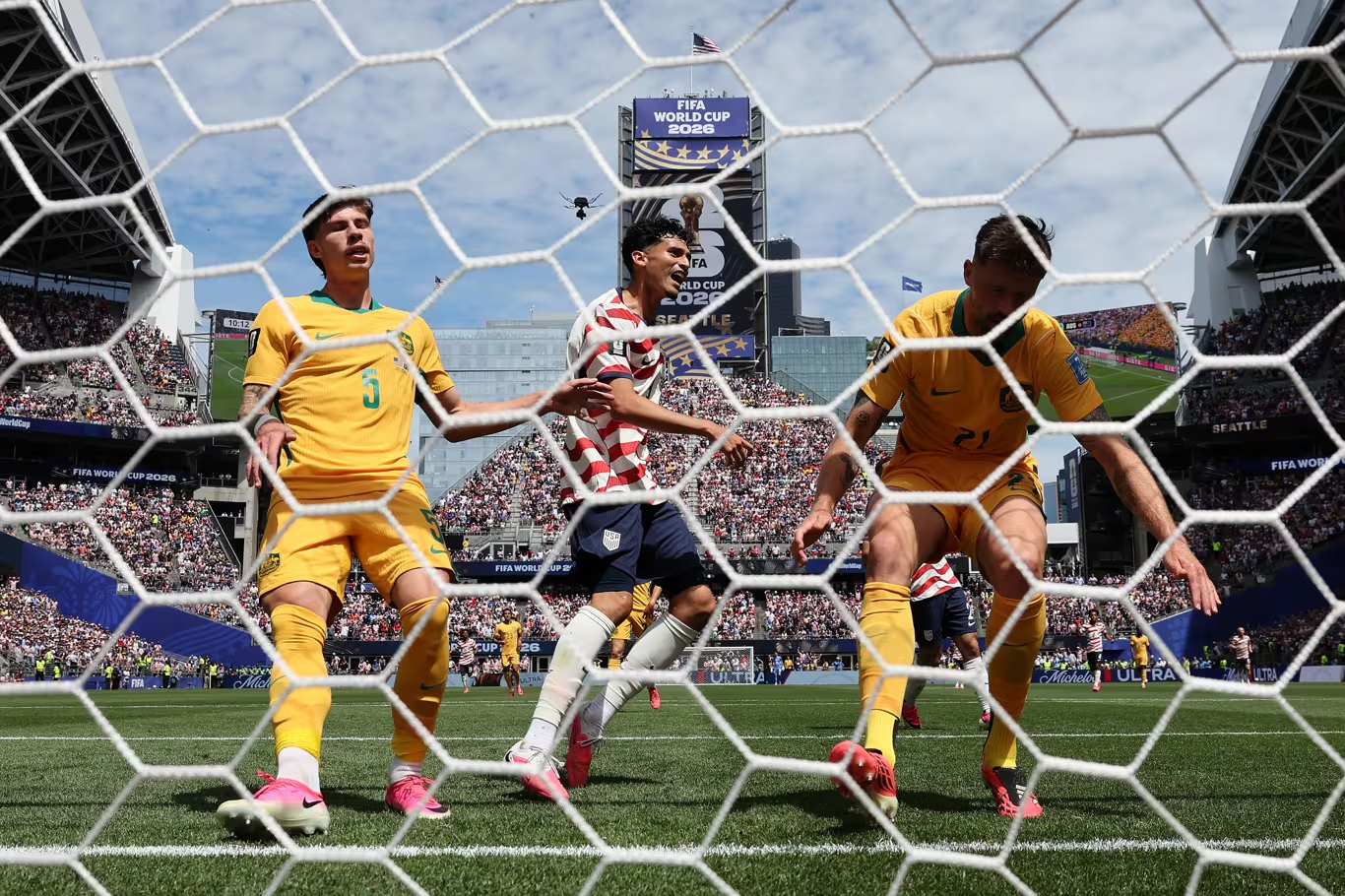
Table of Contents
The sun sat high over Seattle and Christian Pulisic was wearing a tracksuit. For a national team that has spent the better part of a decade learning to lean on one player, that should have been a problem. Instead, the United States walked off the field at Lumen Field with a 2-0 win over Australia, a place in the knockout rounds already locked up, and an answer to the question that has shadowed this group for years.
What happens when the best American is not on the field? On Friday afternoon, at their own World Cup, in front of a sold-out crowd that had come expecting to watch their captain, the United States found out. They were fine. More than fine. Two first-half goals, a clean sheet, top spot in Group D sealed with a game to spare. The Pulisic absence was supposed to expose them. It did the opposite. It showed Mauricio Pochettino something he has spent eighteen months trying to build, and something the rest of the field will not want to see in the knockout rounds.
A Win Built on Other Names
The scoreline did not arrive through the usual channels. The opener came in the 11th minute, when Australia defender Cameron Burgess turned a low American cross into his own net under pressure, the kind of goal that says as much about sustained territory as it does about luck. The second, in the 43rd minute, was scored by Alex Freeman, the 21-year-old full-back whose father won a Super Bowl and who has spent this tournament reminding everyone he chose a different sport. Freeman rose at the back post and headed home, and the United States went into the break two goals up against a side that had stunned Turkey in its opener.
Australia were not poor. Tony Popovic’s team had beaten Turkey 2-0 in their first match, one of the genuine surprises of the group stage, and they arrived in Seattle with belief. Pochettino had warned his players in the build-up that they would have to match the Socceroos for desire before anything else. “They have shown they can compete with anyone in this group,” he said before kick-off, and for twenty minutes Australia pressed and harried and looked the part. Then the United States scored, settled, and took the game away from them with the kind of controlled, front-foot football that has become their signature under the Argentine.
What Pochettino Has Actually Built
When Pochettino took the United States job, the criticism was that he had inherited a team of individuals rather than a system. The talent was obvious. Pulisic at Milan, Weston McKennie at Juventus, Antonee Robinson at Fulham, a generation that had grown up in Europe’s best academies. The doubt was whether they added up to more than the sum of their parts, or whether they would always need Pulisic to produce a moment of magic to drag them over the line.
The win over Australia was the clearest evidence yet that the structure now holds without him. The United States press in coordinated waves, the full-backs push high to turn a back four into a back three in possession, and the midfield rotates to give the man on the ball a passing option in every direction. It is a system that does not depend on one player improvising. It depends on eleven players knowing their jobs. McKennie sat deeper and controlled the tempo. Robinson and Freeman gave the team width without the ball ever having to find Pulisic’s feet. The goals came from a defender’s mistake and a full-back’s header, which is exactly the kind of distributed scoring a team needs when its talisman is unavailable.
There is a deeper point here about squad depth. For most of the last cycle, the United States looked thin behind their first eleven. An injury to Pulisic or McKennie felt like a tournament-ending event. Pochettino has spent his window widening that base, handing minutes to players who would once have been passengers and trusting them to deliver on the biggest stage. Freeman is the obvious example. A year ago he was a curiosity. Now he is scoring World Cup goals while the captain watches from the bench.
The Pulisic Question Does Not Disappear
None of this means the United States are better off without Christian Pulisic. They are not. He was the standout player in the 4-1 win over Paraguay at SoFi Stadium before a blow to the leg forced him off at half-time, and he remains the one American capable of deciding a knockout match on his own. The calf injury that kept him out against Australia is being managed carefully, with the medical staff treating the final group game against Turkey as the line in the sand for his return. Pochettino has the luxury of caution because the group is already won.
That luxury is the whole story. A month ago, a Pulisic injury at the World Cup would have triggered panic across American soccer. Instead, the team has banked six points, topped the group, and bought their best player time to heal without the result hanging on his recovery. The knockout calculus changes when you know the system can win on its own and the difference-maker is still to come. Few teams left in this tournament can say both things at once.
A Knockout Path Comes Into Focus
By finishing top of Group D, the United States have set themselves up for a round-of-32 tie on July 1 at Levi’s Stadium in Santa Clara, a short drive from their World Cup training base in Irvine. The identity of the opponent will not be confirmed until the rest of the first round plays out, with the Americans set to face a third-placed finisher, most likely the winner of the Bosnia and Herzegovina against Qatar match. On paper, it is a kind draw for a host nation that has spent years being told it lacked the temperament for tournament knockout football.
Home advantage is real and it is growing. The crowds have been enormous and loud, the travel has been short, and the players have spoken about the strange, powerful feeling of playing a World Cup in front of friends and family rather than in a distant time zone at three in the morning back home. A team that wins its group, rests its captain, and still controls matches is a team building momentum at exactly the right moment.
From Counter-Punchers to Controllers
To understand why the Australia win felt significant, it helps to remember what this team used to be. For most of the last decade, the United States were counter-punchers. They sat in a mid-block, soaked up pressure, and relied on the pace of Pulisic and the runners around him to spring forward in transition. It was effective against superior opponents and frustrating against inferior ones, because when teams sat back and invited the Americans to break them down, the United States too often had no plan beyond giving the ball to Pulisic and hoping.
Pochettino has flipped that identity. Against both Paraguay and Australia, the United States dominated the ball, set the tempo, and forced the opposition to react to them. The 4-1 win over Paraguay was a statement of intent, four goals against a side that had reached the previous World Cup’s knockout rounds. The Australia performance was the more mature follow-up, a controlled afternoon against opponents who wanted a scrap. Tyler Adams, captaining the side through years of injury setbacks, sat in front of the back line and strangled Australia’s best moments before they started. Veterans like Tim Ream, still defending at 38, brought a calm that this group once lacked entirely.
It is the difference between a team that survives matches and a team that decides them. The United States are no longer waiting to be good. They are imposing themselves, and they are doing it in a tournament where the host nation carries the hopes of a country that has never quite trusted its own footballers to deliver when it counts.
The wider significance reaches beyond this one result. The United States has hosted a men’s World Cup before, in 1994, and the lasting image of that tournament was a penalty shootout exit in the round of 16 and a sport that struggled to convert a summer of interest into something permanent. This generation arrives with a different inheritance. They are products of a professional league, European academies, and a federation that gambled on a high-profile foreign coach. Beating Australia without Pulisic is a small thing on its own. As proof that the project works, it is a large one.
There is a long way to go, and the knockout rounds have a way of humbling teams that look settled in the group stage. But for one sunlit afternoon in Seattle, the United States answered the question that has defined them. They do not need Christian Pulisic to win a football match. They will simply be far more dangerous when he walks back out to join them.

Leave a Comment
More in News
Mourinho Blasts Referee After Atletico Avoid Two Red Cards in Madrid Derby

Cole Palmer Withdraws From England Squad as Gibbs-White Returns Again
Marseille Fans Turn on Owner McCourt as Gomes Can’t Prevent Fifth Straight Loss

Juventus Fans Turn Backs on Silence for Mazzola, Club Slams ‘Lack of Respect’

Trent Alexander-Arnold Returns to the England Squad for the First Time in Over a Year, and Cole Palmer Is Back Too After Their World Cup Snub
Trending on Futbol Chronicle
What Is Offsides in Soccer? The Offside Rule Fully Explained
The Best Soccer Players of All Time: The 10 Greatest Ever Ranked
The Best World Cup YouTubers to Follow in 2026
Arab football federations back Gianni Infantino as FIFA president faces growing opposition