Luka Modric Played Football in a Refugee Hotel and Returns at Forty to Face England
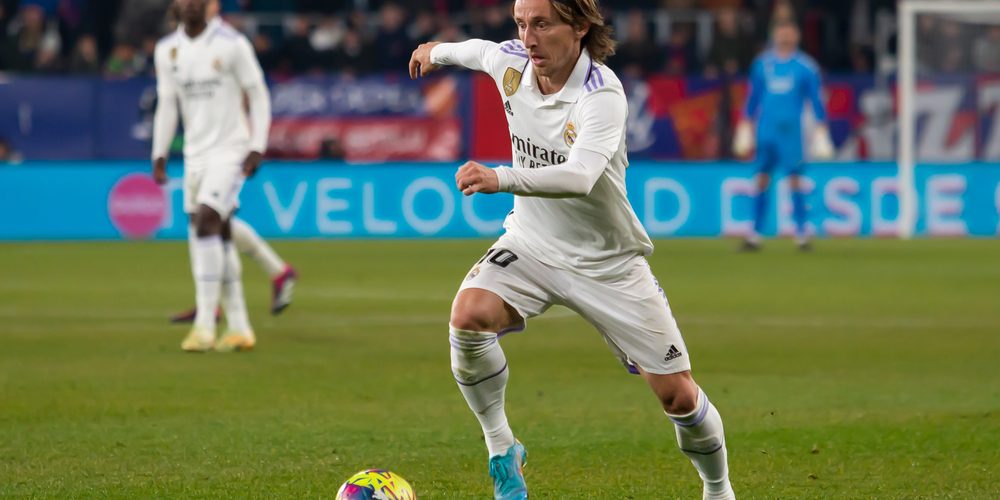
Table of Contents
There is a coach in Zadar who has told the same story for more than thirty years, and it never loses its power. He had heard, he said, about a little hyperactive boy who was constantly playing with a football in the corridor of a refugee hotel, a boy who even took the ball to bed with him. That boy had no proper pitch, no academy, no certainty that the building he slept in would still be standing in the morning. His country was at war. His grandfather had been murdered. And he played, relentlessly, against the cold concrete of a hotel corridor because it was the only place he had.
That boy is Luka Modric. On Wednesday, at the age of forty, he is set to walk out at AT&T Stadium in Arlington to open the World Cup against England, the country he broke the hearts of in Moscow eight summers ago. It will almost certainly be the last World Cup of a career that should never have been possible, and to understand why it carries so much weight, you have to go back to the corridor, and to the war that nearly ended everything before it began.
A Childhood the War Tried to Erase
Modric was born in September 1985 near Zadar, on the Dalmatian coast of what was then Yugoslavia. He spent his earliest years in the hamlet of Jasenice, in the rugged country beneath the Velebit mountains, where his grandfather tended cattle. When the Croatian War of Independence reached the region, the violence was immediate and personal. In December 1991, Serbian militia captured the elder Luka Modric, the grandfather the footballer is named after, on a road near the family’s home and executed him along with several other locals. The footballer was six years old.
The family fled. For much of his childhood Modric lived as a displaced person in hotels in Zadar that had been turned over to refugees, places where running water and electricity were not guaranteed and the sound of shelling was part of daily life. The family home in Jasenice was abandoned and, for years afterwards, the surrounding land carried signs warning of mines. It is one of the starkest facts about one of the most decorated midfielders in history. The house he was born into still stands empty, in a landscape his family could not safely return to.
Football was the escape and the obsession. He played in hotel car parks and corridors, on whatever surface presented itself, with a constant ball at his feet. The technique that would later make him a Ballon d’Or winner was forged in those tight, unforgiving spaces, where there was no room to be wasteful and every touch had to count.
Too Small, Too Frail, Too Slight
Talent alone did not open doors. Modric was repeatedly judged too small and too physically slight to make it. Hajduk Split, the giant of Dalmatian football, passed on him as a teenager, unconvinced that a boy so light could survive the professional game. It is a verdict that has aged about as well as any in football history.
Dinamo Zagreb took the gamble instead, and then sent him out to be hardened. A loan to Zrinjski Mostar dropped him into the Bosnian top flight, one of the most physical and hostile leagues in the region, where opponents tried to kick the slight playmaker out of games. He responded by being named the league’s best player. Another loan, to Inter Zapresic, followed. By the time he returned to Dinamo for good he was no longer a question mark. He was the most coveted young midfielder in the Balkans.
From Doubted Signing to the Best in the World
The doubts did not stop when he reached the elite. Tottenham Hotspur signed him in 2008, and plenty in England wondered whether a player of his build could cope with the Premier League’s intensity. He answered by becoming Spurs’ most influential creator. When Real Madrid paid to take him in 2012, the scepticism reached its peak. A Spanish newspaper poll voted him the worst signing of the season after a difficult start, a judgement that now reads like comedy.
What followed was one of the great midfield careers in the history of the sport. Modric became the metronome of a Real Madrid side that won the Champions League repeatedly, the calm centre around which galacticos revolved. In 2018 he won the Ballon d’Or, ending a decade in which Lionel Messi and Cristiano Ronaldo had shared every single award between them. The boy from the refugee hotel had become, officially, the best footballer on the planet.
Even now he refuses to slow down on schedule. In the summer of 2025 he left Real Madrid and joined AC Milan, swapping the iconic number ten he wore in Spain for the number fourteen in Serie A. Rather than drift into a ceremonial farewell, he has been named man of the match again and again in Italy, controlling games at forty as if the calendar were a rumour.
The Man Who Broke England’s Heart
For English supporters, Modric is more than an opponent. He is the author of one of the most painful nights in the country’s recent footballing memory. In the 2018 World Cup semi-final in Moscow, England led inside five minutes through a Kieran Trippier free-kick and seemed, for the first time in a generation, to be marching to a final. Then Croatia, marshalled by Modric in the middle, slowly took the game away. Ivan Perisic equalised in the second half, Mario Mandzukic struck in extra time, and England’s golden chance was gone. Croatia 2, England 1.
Eight years later, the draw has delivered a rematch nobody in England asked for. Croatia open England’s Group L campaign, and the man at the heart of the side that ended the dream in Moscow is still there, older and slower but no less clever. England arrive as clear favourites this time, one of the tournament’s leading contenders. Croatia arrive with a forty-year-old conductor who has already proven, on the grandest night, that he knows exactly how to silence them.
The Last Dance at Forty
This is, in all likelihood, the final act. Modric has reached the semi-finals or better in two of the last three World Cups, dragging a nation of fewer than four million people to heights that defy every logic of population and resources. At forty he cannot run a tournament the way he once did, but he does not need to. His value now is in tempo, in positioning, in the unhurried authority of a man who has seen everything the game can throw at him and survived far worse off the pitch.
There is something fitting about a career that began in a war ending on the biggest stage the sport can offer, in a country at peace, in a stadium built for spectacle. Modric has spoken often about how the hardship of his childhood gave him a perspective that football pressure could never match. When you have lost your grandfather to a militia and grown up among landmine warnings, a World Cup semi-final is a privilege, not a burden.
So when the teams line up in Arlington and the forty-year-old in the Croatia shirt takes his first touch, England will be facing far more than an ageing midfielder. They will be facing the boy from the hotel corridor, the one who took the ball to bed because it was the only thing the war could not take from him. He has been written off as too small, too frail and too old for almost his entire life. He has made a habit of proving every last one of those verdicts wrong, and he has one more World Cup left to do it again.
What He Means to a Nation of Four Million
To grasp Modric’s standing, it helps to remember the scale of what Croatia keep doing. This is a country with a population smaller than many single cities, a nation that only became independent during the war that shaped his childhood, and yet it has reached a World Cup final and two semi-finals inside a decade. No serious account of that run leaves out the captain. He has been the thread connecting every overachievement, the player teammates look to when matches tighten and tournaments threaten to slip away.
His leadership is not the shouting kind. Those who have played alongside him describe a quiet, almost obsessive professionalism, a man who trains as if he were still trying to earn a contract at Dinamo. Younger Croatian internationals talk about him as a standard-setter rather than a motivator, someone whose example in the gym and on the training ground says more than any dressing-room speech. For a generation of Croatian boys who grew up watching Moscow in 2018, he is the proof that the smallness of a country need not limit the size of its ambitions.
That is the player England must now find a way past. Tuchel’s side will rightly fancy themselves, with younger legs and greater strength in depth, and the smart money says this is England’s tie to lose. But football has a long memory, and so does Modric. He has spent a lifetime being underestimated, from Hajduk Split to the worst-signing polls in Madrid, and he has spent a lifetime making that underestimation look foolish. One more World Cup, one more chance to remind England exactly who he is.

Leave a Comment
More in News

Nottingham Forest Agree £22m Deal to Reunite Daniel Munoz With Oliver Glasner

Moyes Says Everton Supporters Are Not Wrong to Fear Losing Harrison Armstrong

Iraola Faces Alexander Isak Puzzle as Liverpool Search for Their First Win

De Zerbi Admits Finding the Right Mentality Is Tottenham’s Biggest Challenge

Emiliano Martinez Closes In On Chelsea Move After Robert Sanchez Error
Trending on Futbol Chronicle
Michael Carrick admits Manchester United have “no excuses” after AC Milan defeat
The Best World Cup YouTubers to Follow in 2026
Why Soccer Is The Best Sport
Arab football federations back Gianni Infantino as FIFA president faces growing opposition