Switzerland question Embolo red card after World Cup exit to Argentina
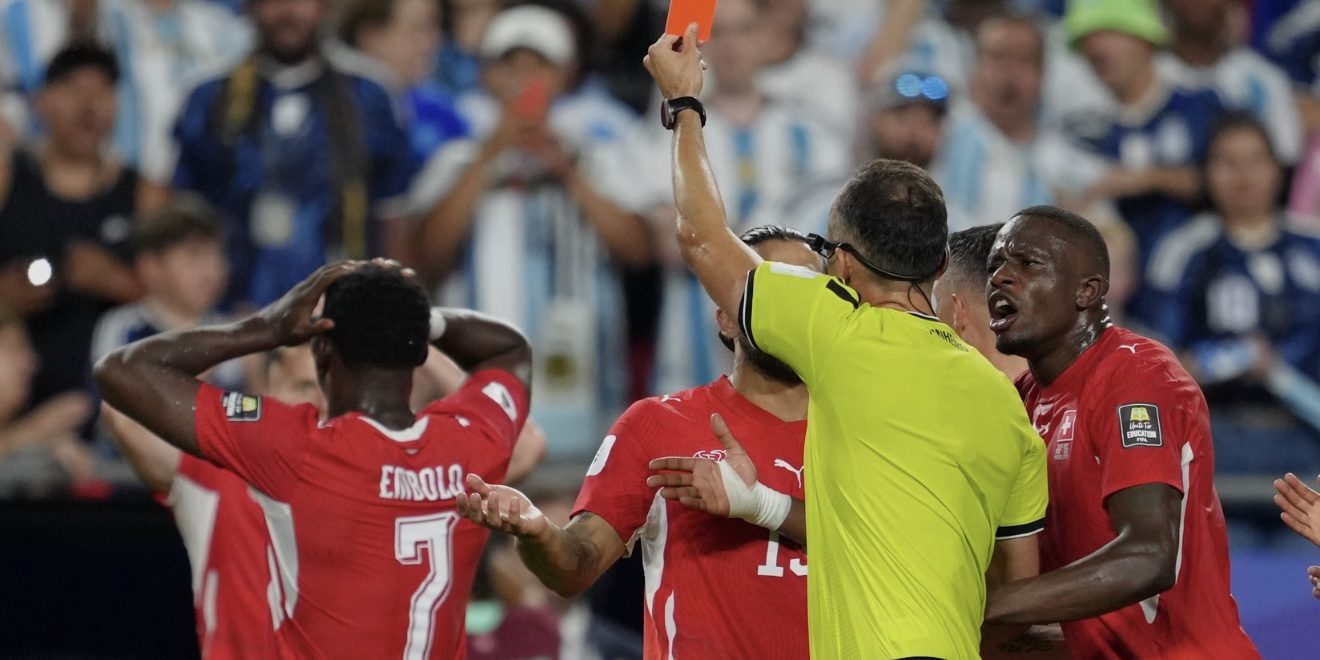

- Switzerland criticised the decision to send off Breel Embolo during their World Cup quarterfinal defeat to Argentina.
- Embolo received a second yellow card for simulation following a VAR review, leaving Switzerland to play with 10 men.
- Murat Yakin and Granit Xhaka said the dismissal changed the match as Argentina scored twice in extra time to advance.
Switzerland were left frustrated after Breel Embolo was sent off during their 3-1 extra-time defeat to Argentina in the World Cup quarterfinals, with coach Murat Yakin and several players questioning the decision that left the Swiss to finish the match with 10 men.
Embolo was dismissed after receiving a second yellow card for simulation following a VAR review.
Referee initially booked Argentina midfielder Leandro Paredes for a challenge on Embolo, but replays showed the Switzerland forward beginning to fall before contact was made.
Because Embolo had already been cautioned earlier in the match, the review resulted in his second yellow card and subsequent dismissal.
The incident came shortly after Dan Ndoye had equalised for Switzerland, with the score level at 1-1.
“I just don’t understand how VAR can make that kind of decision,” defender Nico Elvedi said after the match.
Yakin said the dismissal halted Switzerland’s momentum at a crucial stage of the contest.
“After the equalizer, we had the momentum on our side, and I wanted to make substitutions there as well, to bring on fresh attacking players,” Yakin said.
“We were dominant.”
“We controlled the game.”
“But the red card, we are punished because of a rule that is, to me, absolutely incomprehensible.”
“Of course it hurts enormously that we were eliminated in this way.”
“We didn’t deserve that today.”
The incident marked only the second time a yellow card has been overturned using the World Cup’s mistaken identity protocol, which allows the video assistant referee to intervene when the wrong player has been cautioned or sent off.
Had Paredes not initially been shown a yellow card, the review would not have been possible under the current protocol.
Yakin argued the original booking should never have been issued.
“For me there was not a single reason to give the Argentine player a yellow card,” he said.
“He simply should have let play continue.”
“He corrected his own mistake against us, and afterward you could see that we were playing with one fewer man.”
“They protect their referee over a rule that destroyed our game today.”
“That hurts enormously.”
Embolo was visibly emotional after leaving the field and was comforted by teammates on the bench.
“You can imagine how Breel feels,” Yakin said.
“He had been attacked several times beforehand, and he had two or three good phases in the attacking game.”
“But afterward he could no longer help the team.”
“To blame him now is absolutely absurd.”
“He always works for the team.”
Argentina capitalised on their numerical advantage in extra time, with Julián Álvarez and Lautaro Martínez scoring to secure a place in the World Cup semifinals.
Captain Granit Xhaka admitted the dismissal had a decisive impact on the outcome.
“I think the red card changed our game,” Xhaka said.
“This decision was difficult to accept now after the game because the dressing room was very quiet, disappointed.”
Embolo became the fourth player in the past 60 years to receive a second yellow card for simulation at a men’s World Cup, joining Mexico’s Luis Pérez in 2006, Ghana’s Asamoah Gyan in 2006 and Italy’s Francesco Totti in 2002.

Leave a Comment
More in News
Tuchel and Bellingham’s Uneasy Rivalry Is Fuelling England’s Charge to the Argentina Semi-Final
Mbappe and Yamal Bring Their Rivalry to a World Cup Semi-Final for the First Time

Andoni Iraola vows to reconnect Liverpool with supporters as new era begins at Anfield

Manchester United target Youri Tielemans as midfield plans change after Ederson setback
Infantino confirms FIFA will discuss potential 64-team World Cup expansion
Trending on Futbol Chronicle
The Best Soccer Players of All Time: The 10 Greatest Ever Ranked
Why Soccer Is The Best Sport
The Best World Cup YouTubers to Follow in 2026

Map of All the Premier League Teams for 2025/26