
How the 48 Team World Cup Turned Aging Goalkeepers Into Overnight Folk Heroes
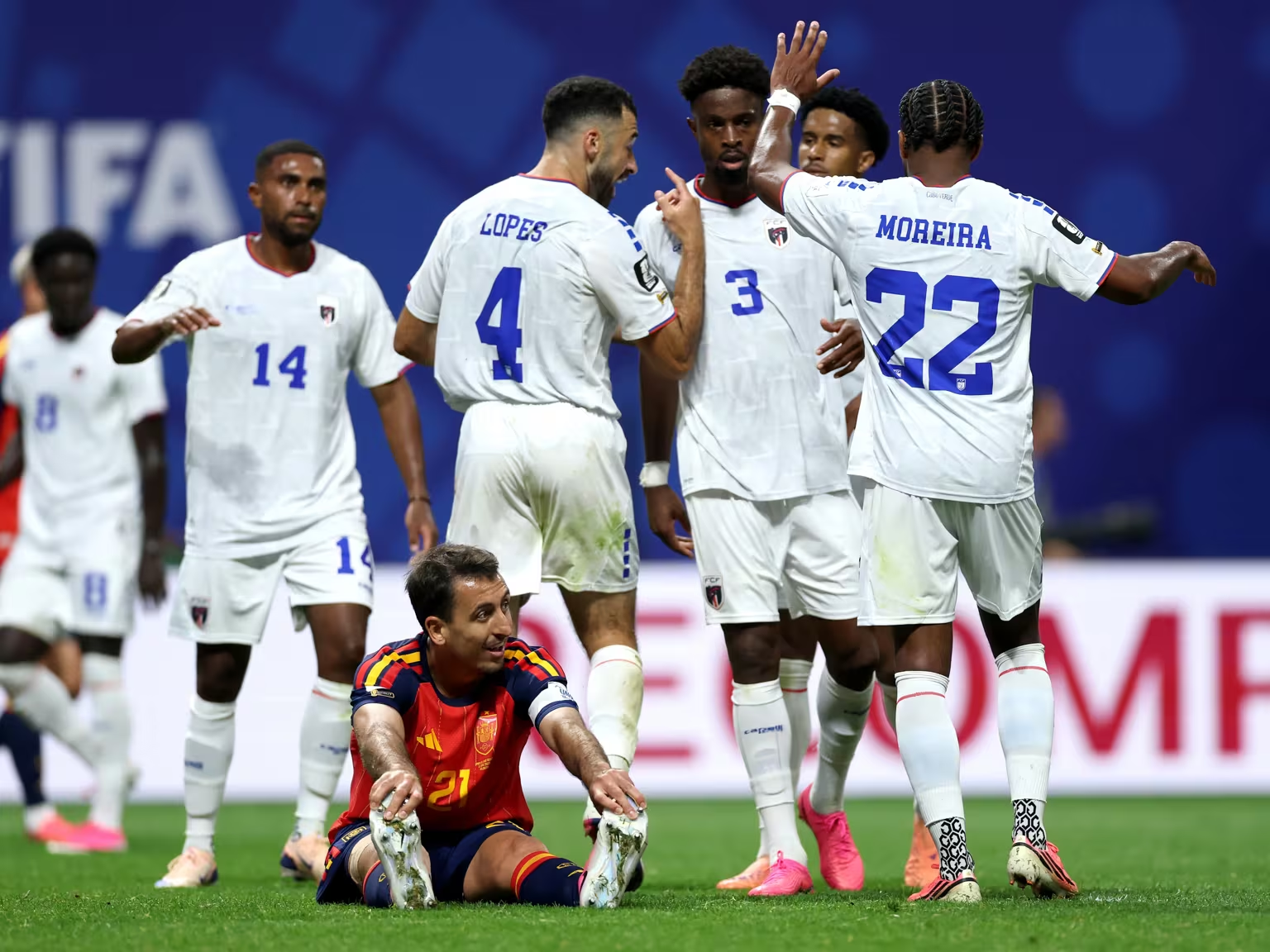
Table of Contents
In the days after Cape Verde’s forty year old goalkeeper Vozinha threw himself across his goal to deny Spain again and again, his Instagram following climbed from around 32,000 to more than twelve million. That is an increase of roughly 37,000 percent, the kind of number usually reserved for pop stars and scandals. He had spent two decades as a name known only to people who follow the islands off the coast of West Africa. One afternoon against the European champions turned him into a global folk hero. He is not alone. This World Cup has belonged, more than any in living memory, to the old men in gloves.
The 48-team format was sold as a way to spread the game to nations that had never tasted the finals. What nobody quite predicted was the side effect. By handing places to Cape Verde, Curacao, Uzbekistan and a dozen other debutants and long-absent sides, FIFA also handed the spotlight to a generation of veteran goalkeepers who had spent their careers in obscurity and now found themselves standing between footballing giants and humiliation. They have made the most of it.
The keepers who stole the group stage
Vozinha’s heroics against Spain were the headline act, but the supporting cast was just as compelling. Eloy Room, the Curacao goalkeeper, made fifteen saves in a single match against Ecuador on 22 June, equalling a World Cup record that had stood since 1966. Fifteen. For a nation of roughly 156,000 people, the smallest ever to reach the finals, Room’s afternoon was not a performance so much as an act of defiance, and it earned Curacao a point that their population could scarcely believe.
Then came Benjamin Asare, the Ghana goalkeeper whose story reads like fiction. Before he kept a clean sheet against England in a 0-0 draw that frustrated the Three Lions into knots, Asare had sold plastic bags on the street and driven a bus to make ends meet. He arrived at the World Cup as the least glamorous name in a squad full of Premier League graduates and left the England match as the man who had shut the door on Harry Kane. The Washington Post devoted a feature to the phenomenon, calling them the old, unknown goalkeepers shutting down World Cup giants. The description fit perfectly.
Why the format created them
None of this happens at a 32-team World Cup. The maths is simple. Expanding to 48 teams created sixteen extra places, and those places went overwhelmingly to nations outside the traditional elite. Cape Verde and Curacao would never have qualified under the old system. Uzbekistan reached their first finals decades after a plane crash took their greatest team. These countries do not produce the kind of outfield depth that wins tournaments, but they have something else, which is an experienced goalkeeper who has spent fifteen or twenty years learning his craft far from the cameras.
Goalkeeping is the position where age helps rather than hinders. A thirty eight year old striker has lost a yard. A thirty eight year old keeper has gained a library of positional knowledge that no young talent can fake. When a small nation faces a giant, the game plan is almost always the same. Defend deep, frustrate, and ask the goalkeeper to be the best player on the pitch. The expanded format produced a wave of matches built on exactly that template, and the veterans rose to it.
A Leicester comparison from a man who would know
Kasper Schmeichel, no stranger to defying probability, compared Cape Verde’s run to his own Leicester City side that won the Premier League in 2016 against odds of 5,000 to 1. Schmeichel understands the alchemy that turns a group of overlooked players into a story the world cannot ignore. It starts in goal. Leicester won the title with Schmeichel making save after save behind a back line that defended for its life. Cape Verde reached the World Cup and troubled Spain with the same blueprint, and Vozinha was their Schmeichel.
The comparison is not sentimental. It is tactical. Underdog runs are built on goalkeepers who refuse to be beaten, because a small nation cannot outscore a giant but it can absolutely out-defend one for ninety minutes. The 2026 World Cup has proven the point over and over, and it has done so with men who, in a normal year, would be coaching academy teams or running businesses back home rather than starring on the biggest stage the sport owns.
What it means for the knockouts
The veterans have changed the texture of the tournament. Favourites have learned that a 1-0 lead means nothing when the opposing keeper is in the form of his life, and that taking thirty shots can still produce a goalless draw. Turkiye took sixty two shots without scoring across the group stage at one point, a statistic that captures how stubborn organised defences and inspired goalkeeping have become. The knockout rounds will sharpen the effect. One inspired goalkeeping display in a single elimination match can end the dream of a nation that spent hundreds of millions building its squad.
For the giants, the message is clear. The route to goal has narrowed, and the old assumption that quality always finds a way has been challenged by men who treat every shot as a personal insult. For the smaller nations, the lesson is the opposite and far happier. A great goalkeeper is the great equaliser, the one position where a country of 156,000 can match a country of fifty million, and this tournament has handed them a stage to prove it.
The psychology of the inspired keeper
Ask any goalkeeper and they will tell you that form in their position is part technique and part belief. A keeper who makes one outstanding save early grows two inches for the rest of the afternoon. The forward who should score starts aiming for the corners instead of the net, the defenders in front of him relax, and the whole team feeds off the certainty that the man behind them will not be beaten. Vozinha against Spain was the perfect example. His first save settled Cape Verde, and every save after it made the European champions a fraction less sure of themselves.
That snowball effect is amplified at a World Cup, where the margins are thinner and the consequences final. A veteran keeper has the temperament to ride it. He has seen enough penalties, enough one-on-ones, enough last-minute scrambles to keep his heartbeat steady when a younger man’s would race. Room’s fifteen saves against Ecuador were not fifteen moments of luck. They were fifteen decisions made correctly under pressure that would have overwhelmed most professionals. Experience is the quiet weapon, and the expanded tournament has put it on display match after match.
A pattern with deep roots
Underdog goalkeeping heroics are not new to the World Cup, but they have rarely arrived in such concentration. The history of the tournament is dotted with keepers who became legends for a single summer. The difference in 2026 is volume. Where past editions might produce one breakout shot-stopper, this one has served up a steady procession of them, because the format guarantees a steady procession of mismatches in which a great keeper is a small nation’s only realistic path to a result.
The data backs up the eye test. Shot counts have ballooned in the lopsided fixtures, with favourites piling up attempts and underdogs absorbing them. Turkiye’s sixty two shots without a goal across part of the group stage was the headline figure, but it was not an outlier so much as the extreme end of a trend. When a giant cannot convert thirty chances, the story is almost always the same. The keeper at the other end refused to break, and a nation that had no business holding on held on anyway.
The romance of it has a hard edge for the favourites. Spain, Germany and the rest of the elite have spent fortunes assembling squads designed to win this tournament, and the great equalising power of an inspired goalkeeper threatens to make all that spending irrelevant on any given afternoon. Knockout football compresses the variance into a single match, and a single match is exactly the stage on which a forty year old keeper can write his name into history. The giants know it. It is why managers of the big nations have spent the group stage warning their forwards to be ruthless, because they understand that the next Vozinha is waiting somewhere in the bracket.
The men who made the World Cup feel possible
Football loves a story about youth, about the teenager who arrives and changes everything. This World Cup flipped the script. Its breakout stars have been men in their late thirties and early forties who had made peace with anonymity and then refused to let the moment pass them by. Vozinha will never have a quiet day online again. Room owns a piece of history that has stood for sixty years. Asare went from the bus depot to keeping out England.
They will not all survive the knockouts, and most of their nations will be home before the quarter-finals. That is not the point. The expanded World Cup promised to widen the circle of who gets to dream, and it delivered on that promise through the most unlikely heroes the sport could have chosen. The old men in gloves did not just show up. They reminded everyone watching that experience, patience and sheer bloody-mindedness can still steal the show from the millionaires.

Leave a Comment
More in News

Thierno Barry Was Filmed Crying In A Private Training Session Last Season, And He Has Already Scored In Three Games This Campaign

Gravenberch’s Red Card Sparks Referee Row in Liverpool’s Defeat to City

Moise Kean Will Miss Como’s Biggest Game of the Season After Cesc Fabregas Clashed With Italy’s Doctors

Oliver Glasner Returned to Crystal Palace and Fans Turned From Applause to Taunts as Forest Lost
Vinicius Red Card for Hair Pull Leaves Mourinho Snubbing the Press
Trending on Futbol Chronicle

Josef Martinez Returns to MLS Spotlight With Columbus Crew Signing
Mikel Arteta backs ‘warrior’ Bruno Guimarães to make Arsenal stronger

What Is The Club World Cup?

Michael Carrick points to lack of sharpness after Manchester United draw with West Ham