
What Is Offsides in Soccer? The Offside Rule Fully Explained
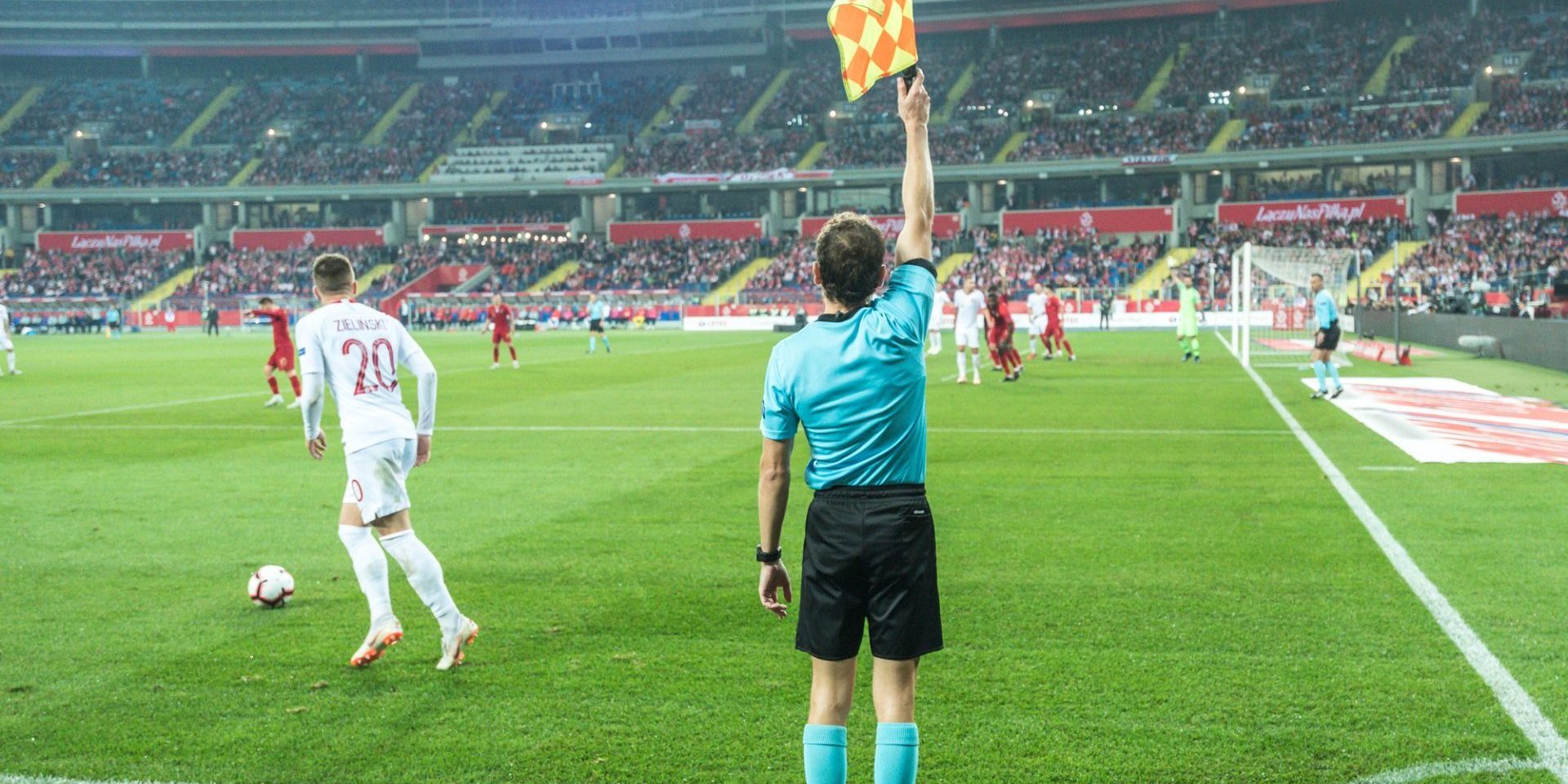

Table of Contents
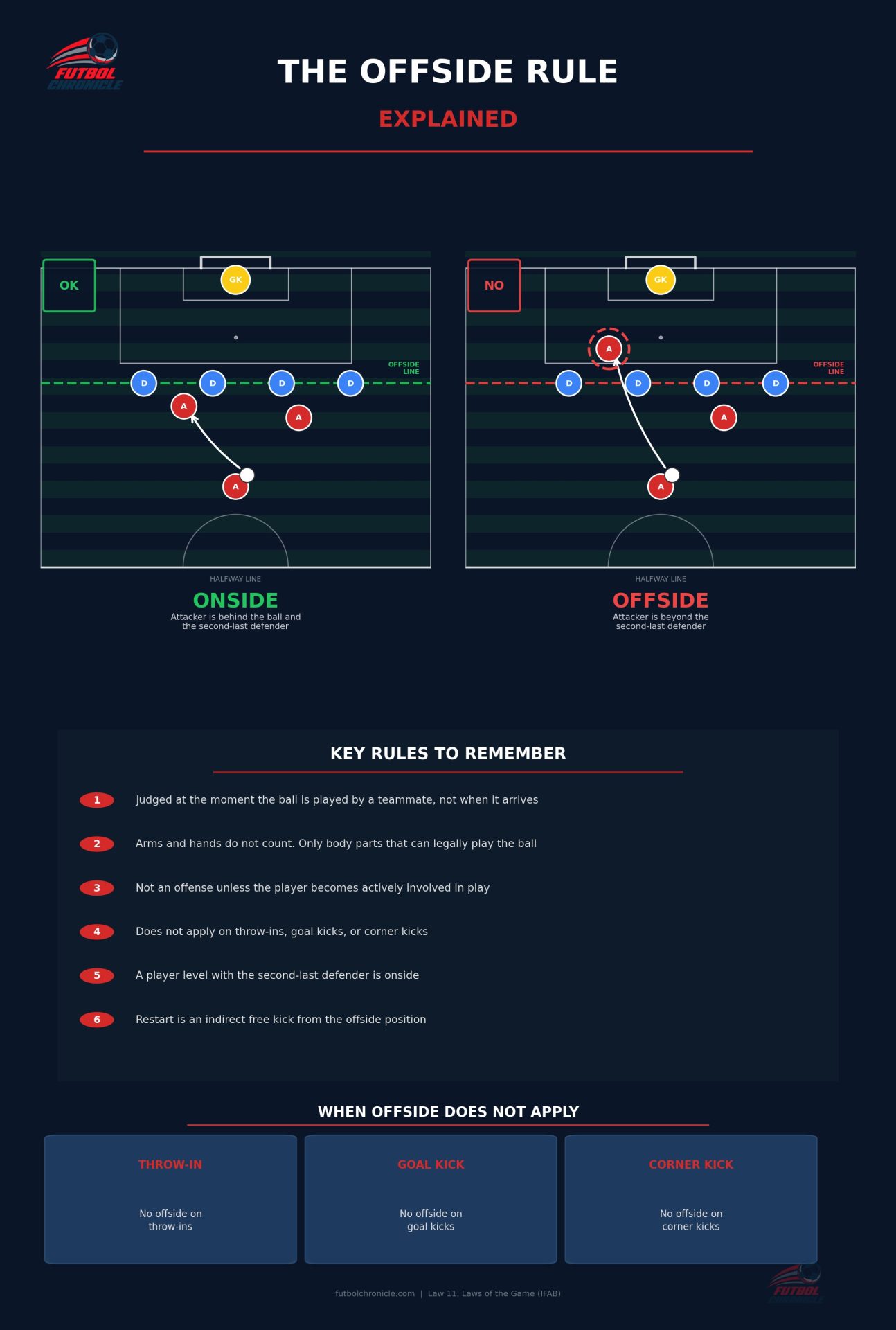
- A player is offside if any part of their head, body, or feet is closer to the opponent’s goal line than both the ball and the second-last defender at the moment a teammate plays the ball.
- Being in an offside position is not an offense on its own. A player must become actively involved in play to be penalized.
- The rule does not apply on throw-ins, goal kicks, or corner kicks. Hands and arms are excluded from the assessment entirely.
How the Offside Rule Works in Soccer
The offside law exists to prevent attackers from standing behind the defense and waiting for a long ball. Without it, football would be a sport of punt-and-chase, with strikers camped on the goalkeeper’s line. The rule forces attacking players to time their runs and rewards teams that can break defensive lines with movement and passing, rather than static positioning.
It is codified as Law 11 of the Laws of the Game, maintained by the International Football Association Board (IFAB). Every professional league, from the Premier League to the Copa Libertadores, applies the same version of the rule.
The Offside Position
A player is in an offside position when, at the exact moment a teammate plays or touches the ball, all three of the following are true: the player is in the opponent’s half of the pitch (the halfway line itself is not considered the opponent’s half), any part of the player’s head, body, or feet is nearer to the opponent’s goal line than the second-last defender, and any part of the player’s head, body, or feet is nearer to the opponent’s goal line than the ball.
In most situations, the goalkeeper is the last defender, so the offside line is effectively set by the deepest outfield defender.
Hands and arms are excluded from this assessment for all players, including the goalkeeper. A striker whose arm extends beyond the last defender is not offside. Only body parts that can legally play the ball count.
A player who is exactly level with the second-last defender is onside. The benefit of the doubt, by rule, goes to the attacker.
When Offside Becomes an Offense
Being in an offside position is not illegal. Thousands of players stand in offside positions during any given match without being penalized. The offense only occurs when a player in an offside position becomes involved in active play at the moment the ball is played by a teammate.
IFAB breaks active involvement into three categories.
The first is interfering with play. The player touches or plays a ball passed or touched by a teammate. This is the most common type of offside call. A forward who receives a through ball while standing beyond the last defender is the textbook example.
The second is interfering with an opponent. The player prevents a defender from playing the ball, even without touching it. That includes blocking a goalkeeper’s line of vision, making a gesture or movement that deceives or distracts an opponent, or challenging an opponent for the ball. A player standing in front of the goalkeeper during a free kick, while in an offside position, can be flagged even if they never touch the ball.
The third is gaining an advantage. The player benefits from being in an offside position by playing a ball that rebounds off the goalpost, crossbar, or a match official, or by playing a ball that deflects off a defender. If a shot hits the post and falls to a player who was offside when the shot was taken, it is an offense.
Deliberate Play vs. Deflection
One of the most contentious areas of the modern offside rule involves the distinction between a defender who deliberately plays the ball and a ball that merely deflects off a defender.
If a defender deliberately plays the ball (a clearance, a pass, or an attempt to control it), and the ball then reaches an attacker who was in an offside position, no offside offense has occurred. The logic is that the defender’s intentional action created a new phase of play.
If the ball deflects off a defender (an unintentional touch, a ricochet off a shin, or a ball that strikes a defender who had no time to react), the attacker remains offside. The deflection does not reset the phase of play.
IFAB updated its guidelines in 2023 to clarify the criteria referees should use. The key factors are whether the defender had a clear view of the ball, had time to coordinate their body movement, and had control over their action. A defender lunging at a cross and getting a toe to it may still be judged to have deliberately played the ball, even if the touch was not clean.
This distinction is reviewed by VAR on a case-by-case basis and remains one of the most debated areas of officiating.
When Offside Does Not Apply
The offside rule is suspended entirely in three specific situations:
On a throw-in, a player cannot be offside. If a teammate takes a throw-in and the attacker is standing beyond the last defender, play continues without interruption.
On a goal kick, offside does not apply. Attackers are free to position themselves anywhere on the pitch while the goal kick is taken.
On a corner kick, offside does not apply. A player receiving the ball directly from a corner cannot be called offside.
These exceptions only apply to the moment the ball is delivered from the restart itself. Once a second player touches the ball after a throw-in, goal kick, or corner, normal offside rules resume.
Offside also does not apply if a player receives the ball directly from a drop ball.
The Goalkeeper Exception and the Second-Last Defender
The offside line is set by the second-last defender, not specifically the goalkeeper. In most cases, the goalkeeper is the deepest player and the last line of defense. The offside line then falls to the last outfield defender.
If the goalkeeper moves upfield (during a late-game push for an equalizer, for example), and an outfield defender is now the deepest player, the offside line is set by the second-deepest player. This can create unusual situations where the offside line is much higher than expected.
The Offside Trap
The offside trap is a defensive tactic where the back line deliberately pushes forward in unison just before an opponent plays the ball, leaving attacking players in offside positions. The aim is to catch forwards behind the defensive line and win an indirect free kick without having to tackle.
Teams like AC Milan under Arrigo Sacchi in the late 1980s and Arsenal under George Graham in the early 1990s became famous for executing the offside trap with precision. The risk is obvious: if the defensive line mistimes the push, or if the assistant referee misses the call, the attacker is through on goal with no cover.
In the modern game, the offside trap remains a common tool, though high defensive lines carry greater risk with VAR now able to check tight calls with millimeter accuracy.
A Brief History of the Offside Rule
The offside rule has been part of association football since the sport was codified. Its shape has changed repeatedly over 160 years, and each major revision reshaped how the game is played.
In 1863, the newly formed Football Association published the first Laws of the Game. The original version effectively banned all forward passes. Any player ahead of the ball was offside, similar to modern rugby.
By 1866, the rule was amended. A player was now onside if three opponents (typically two defenders and the goalkeeper) were between them and the goal line at the moment the ball was played. This opened up the game to forward passing.
In 1925, the rule was changed from three opponents to two. This single amendment had an immediate and dramatic effect: goal tallies surged across English football. The change was introduced because defensive teams had become too effective at playing the offside trap under the old three-player rule, and matches had become low-scoring and dull.
In 1990, IFAB amended the rule so that a player level with the second-last defender was considered onside. The previous interpretation had treated “level” as offside. This gave a marginal advantage back to attackers and formalized the “benefit of the doubt” principle.
In 2003, IFAB introduced the concept of “active play.” Being in an offside position was no longer automatically an offense. A player had to be involved in the play, interfere with an opponent, or gain an advantage. This was a landmark change that introduced the idea of “passive offside.”
In 2023, IFAB clarified the deliberate play guidelines to help referees and VAR distinguish between intentional clearances and accidental deflections, addressing one of the most persistent gray areas in the law.
In 2025, a further clarification was added for goalkeeper throws. When a goalkeeper throws the ball upfield, the offside assessment is now made at the point the ball leaves the goalkeeper’s hand, using the last point of contact.
How Offside Is Enforced: From Flag to SAOT
For over a century, offside was enforced by the assistant referee (formerly the linesman), who would raise their flag to signal an offside offense. The assistant’s job is to watch the defensive line and the attacker simultaneously while also tracking the moment the ball is played. It is one of the hardest judgment calls in any sport.
The introduction of Video Assistant Referee (VAR) technology in the late 2010s brought frame-by-frame review to offside decisions. The Premier League introduced VAR for the 2019/20 season. While VAR improved accuracy, it also introduced delays and controversy around tight marginal calls. Goals were disallowed because a player’s shoulder or knee was centimeters beyond the defensive line, decisions invisible to the naked eye.
Semi-Automated Offside Technology (SAOT) is the latest development. FIFA first deployed SAOT at the 2022 World Cup in Qatar. The system uses up to 30 cameras installed around the stadium, each capturing footage at 100 frames per second. These cameras track up to 10,000 surface data points per player, creating a real-time skeletal mesh of every person on the pitch.
When a potential offside situation arises, SAOT automatically identifies the kick point (the moment the ball is played), draws the offside line on the second-last defender, and highlights the relevant body part of the attacker. The VAR then reviews the automated output and confirms or overrides the decision.
The Premier League introduced SAOT on 12 April 2025, during Matchweek 32 of the 2024/25 season. It saved an average of 27 seconds per offside review in its first weeks of operation. The technology has been in full use across the 2025/26 season. The FA Cup began using SAOT in the fifth round in February 2025, and the Bundesliga, Serie A, and La Liga have all adopted versions of the system.
SAOT is called “semi-automated” because human judgment is still required. The technology cannot determine whether a player is actively involved in play. It cannot assess intent or identify which player touched the ball. The VAR retains final authority over every decision.
The Penalty for Offside
When an offside offense is called, the restart is an indirect free kick to the defending team. The free kick is taken from the position where the offside player was standing when the ball was played by their teammate, not from where the player received the ball.
An indirect free kick means a goal cannot be scored directly from the kick. Another player must touch the ball before a goal can count.
Common Misconceptions
A player cannot be offside in their own half. If an attacker is standing in their own half when the ball is played, they are onside regardless of where the defenders are positioned.
A player cannot be offside from a throw-in, goal kick, or corner kick. These are the three explicit exceptions written into Law 11.
The arms do not count. A player whose arm extends beyond the defensive line is not offside. Only parts of the body that can legally play the ball (head, torso, legs, feet) are assessed.
Being offside is not the same as being called offside. Players drift into offside positions constantly during open play. The offense only occurs when they become actively involved in the play from that position.
Offside is judged at the moment the ball is played by the teammate, not when the ball arrives. A player can be onside when the pass is made and then run into an offside position before receiving the ball. That is legal. Conversely, a player can be offside when the pass is made and then run back onside before receiving it. That is still offside, because the position at the moment of the pass is what matters.
Sources
Law 11, Offside (IFAB Laws of the Game)
Semi-automated offside technology: What you need to know (Premier League)
Semi-automated offside technology introduced in Matchweek 32 (Premier League)
How does semi-automated offside technology work in football? (The FA)

Leave a Comment
More in News

Arne Slot cautious on Alexander Isak return ahead of Manchester City clash

Pep Guardiola avoids future questions as Manchester City prepare for Liverpool clash

FA warns fixture congestion could impact England performance and FA Cup value

Italy FA president resigns after World Cup qualification failure

Arne Slot calls for Liverpool response ahead of Manchester City FA Cup clash
Trending on Futbol Chronicle

What Is The Club World Cup?

Michael Carrick points to lack of sharpness after Manchester United draw with West Ham

Why Soccer Is The Best Sport