
Why Every Away Team at This World Cup Is Secretly Playing a Home Game
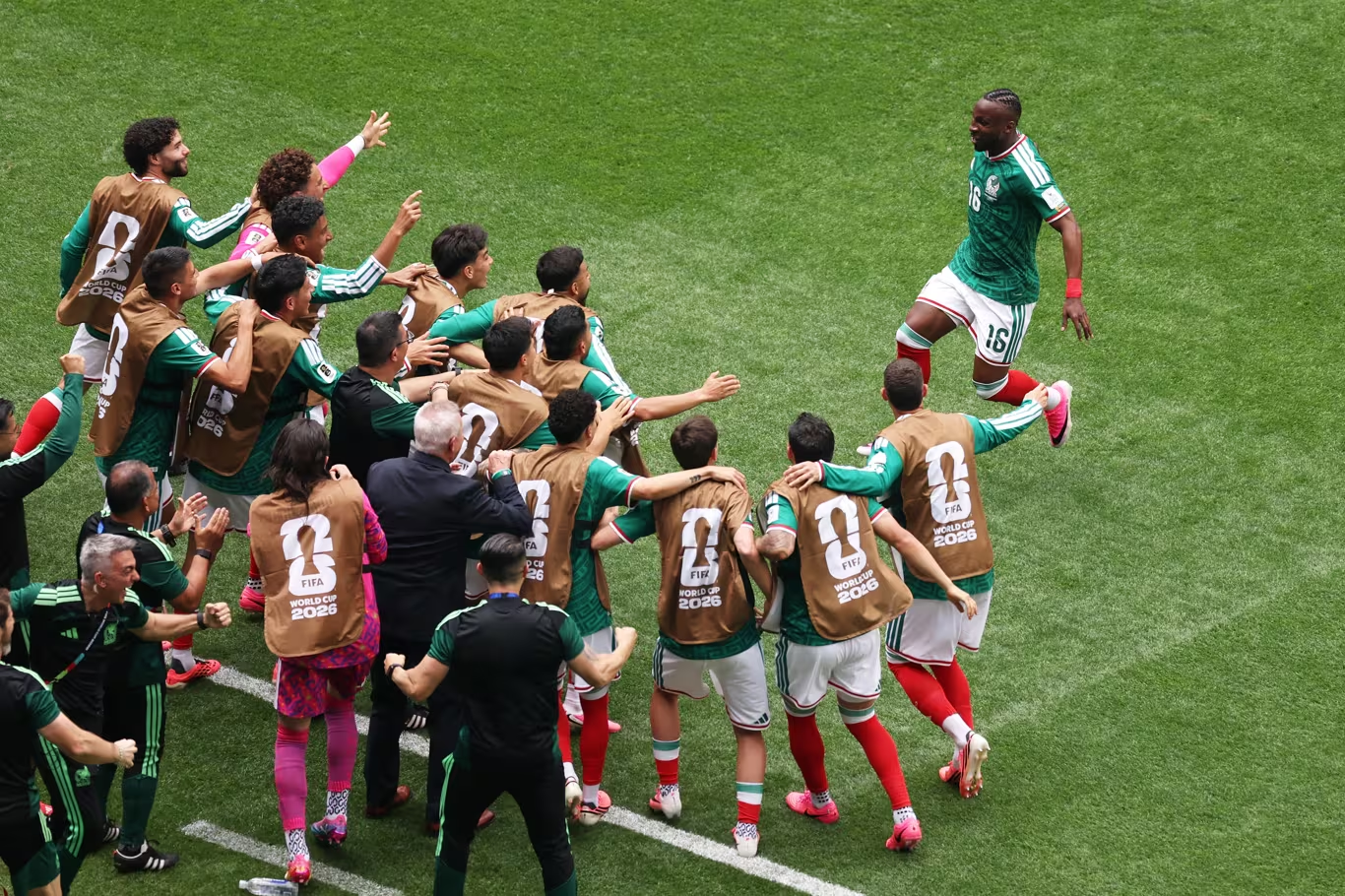
Table of Contents
Here is a strange truth about the 2026 World Cup. There may be no real away teams. When Scotland played Haiti near Boston, more than twenty thousand kilted supporters made the stadium feel like a corner of Glasgow had been airlifted across the Atlantic. When Mexico take the field anywhere in the southern United States, the crowd sings their anthem as if the match were being staged in the Azteca. From the West African communities of New York to the Central American neighbourhoods of Los Angeles, the United States contains a version of nearly every footballing nation on earth, and over the next month those communities are going to fill the stands.
The result is a tournament unlike any before it. The country hosting the largest World Cup in history also happens to be home to the planet’s biggest football loving diaspora. Put those two facts together and you arrive at a peculiar conclusion. At this World Cup, the away team is very often playing a home game, and the host nation may sometimes find itself the visitor in its own stadiums.
A Nation Built From Everywhere
The United States is the product of immigration on a scale no other country can match, and football has travelled with every wave of newcomers. Mexican communities across the southwest have supported El Tri for generations, filling NFL stadiums for friendlies long before Major League Soccer existed. Salvadorans, Hondurans and Guatemalans brought their own loyalties. So did Nigerians, Ghanaians and Senegalese, alongside Colombians, Ecuadorians, Koreans, Poles and dozens more. Each community kept its football allegiance alive, passed it to children born on American soil, and waited for the day the world game would come to them.
That day has arrived. Where a World Cup in Qatar or Russia drew travelling supporters who had to cross continents and budgets to attend, this one offers millions of fans a short drive to watch their nation play. The away support does not need to fly in. It already lives here. For teams from Latin America, the Caribbean and Africa in particular, the local population provides a ready made home crowd in city after city.
When Mexico Is the Home Team
No example is clearer than Mexico. For decades, El Tri have used the United States as a second home, playing more friendlies on American soil than almost anywhere else because the crowds are enormous and reliably green. Stadiums in Los Angeles, Dallas, Houston and Phoenix routinely fill with Mexican supporters whenever the team appears. At this World Cup, that dynamic becomes part of the tournament itself rather than a quirk of the friendly calendar.
The opening match offered an early hint of the appetite. Mexico’s 2-0 win over South Africa drew the biggest Spanish language television audience for a football match in American history, and the noise inside the ground matched the figures on the screen. Wherever Mexico go in the host cities, they will carry that support with them, and opposing teams will quickly learn what it feels like to be outnumbered in a stadium that is supposed to be neutral.
The same will be true, in different shades, for other nations with deep American roots. Colombian supporters will pack out their team’s fixtures. Caribbean communities will turn matches involving their islands into carnivals. Even smaller nations will find pockets of passionate local backing that no World Cup abroad could ever have given them.
The Tartan Army Shows the Way
It is not only the resident diaspora that creates this effect. Some supports travel in such numbers that they manufacture a home atmosphere wherever they land. Scotland’s Tartan Army managed exactly that near Boston, with estimates of between twenty and thirty thousand fans turning the area around the stadium into a tartan occupation. For a nation of just over five million people, that is an extraordinary mobilisation, and it gave Steve Clarke’s team the feel of a home crowd thousands of miles from Hampden Park.
The Scottish support has built its reputation on precisely this, following the team to the ends of the earth and treating each tournament as a festival regardless of the results. They are the travelling extreme of a wider pattern. Across this World Cup, the combination of resident communities and dedicated travelling supporters means very few teams will experience the lonely, hostile away days that define knockout football in club competition. The crowds are too mixed, too passionate, too willing to adopt whichever underdog catches their imagination.
How Teams Are Using the Map
Smart federations have planned around this reality. Spain, the reigning European champions, set up their base camp in Chattanooga, Tennessee, and the simple act of their arrival drew millions of views online as locals turned out to greet them. Teams are choosing training bases and host cities with one eye on the supportive communities nearby, understanding that a friendly local population can be worth a great deal over the grind of a month long tournament.
FIFA has leaned into the theme as well. The official Fan Festival programme will run across thirteen host cities, more than any previous World Cup, surpassing the twelve venues used in Germany in 2006 and Brazil in 2014. These sites are designed as gathering points for exactly the communities that give the tournament its character, spaces where the diaspora can come together whether or not they hold a match ticket. The festivals are an acknowledgement that the story of this World Cup is happening in the streets and squares as much as inside the stadiums.
For coaches, the home game effect introduces a genuine tactical and psychological variable. A team that expects a neutral or hostile crowd may instead find itself roared on by tens of thousands. The energy that an unexpected home atmosphere provides can lift a tired side through the closing stages of a tight match, and the federations that judged their host cities best may reap the reward in the knockout rounds.
What It Means for the United States
There is an irony in all of this for the host nation. The United States men’s team drew close to twenty five million viewers across two languages for its opening win, a figure that proves the country is watching. Yet in the stands, the Americans will not always enjoy the overwhelming home advantage that hosts usually take for granted. When they meet opponents with large local diasporas, the support could be split, or even tilt against them. Hosting the world’s most diverse footballing population is a gift and a complication at once.
For the broader American soccer project, though, the diaspora is the foundation everything else is built upon. These are not casual fans who need converting. They are lifelong supporters whose passion has been waiting for a stage. A World Cup that brings the global game to their doorsteps does not create their love of football. It validates it, and it connects it to the country’s own slowly rising team.
An Echo of 1994
The United States has run this experiment before. When it hosted the 1994 World Cup, sceptics in Europe and South America doubted whether a country without a serious top flight league could fill its stadiums. It answered by setting an aggregate attendance record that still stands more than thirty years later, drawing enormous crowds in large part because the resident communities turned out for their nations. Irish supporters made Giants Stadium a home venue. Mexican fans dominated matches in the west. The diaspora carried that tournament, and the profits from it seeded Major League Soccer the following year.
What has changed since is scale. The country is more diverse than it was in 1994, the immigrant communities are larger and more established, and the tournament itself has expanded from twenty four teams to forty eight, with one hundred and four matches spread across sixteen host cities in three nations. The basic dynamic, though, is the same one that startled the doubters three decades ago. Bring the World Cup to the United States and you do not import an audience. You uncover one that was already living next door, waiting for its team to arrive. The supporters who packed stadiums in 1994 have raised children and grandchildren who will do the same this summer, only in greater numbers and louder voice.
A World Cup of Borrowed Homes
Previous World Cups have had their atmospheres defined by a single host culture. Brazil gave the 2014 tournament its samba colour. Russia and Qatar shaped their editions in their own images. This one is different because it has no single character to impose. It belongs, in a sense, to everyone, because almost everyone is already here. The Mexican fans in Los Angeles, the Scots in Boston, the Nigerians in Houston and the Colombians in New Jersey are not guests at someone else’s party. They are the party.
That is what makes the away team illusion so powerful. On paper there is a host and there are visitors. In the stands the lines blur until they vanish, and a tournament staged across three countries becomes a home fixture for dozens of nations at once. For a month, the United States is not so much hosting the world as revealing how much of the world it already contains. The teams may be the visitors. Their supporters, more often than not, are already home.

Leave a Comment
More in News

Mourinho Blasts Referee After Atletico Avoid Two Red Cards in Madrid Derby

Cole Palmer Withdraws From England Squad as Gibbs-White Returns Again

Marseille Fans Turn on Owner McCourt as Gomes Can’t Prevent Fifth Straight Loss

Juventus Fans Turn Backs on Silence for Mazzola, Club Slams ‘Lack of Respect’

Trent Alexander-Arnold Returns to the England Squad for the First Time in Over a Year, and Cole Palmer Is Back Too After Their World Cup Snub
Trending on Futbol Chronicle

Map of All the Premier League Teams for 2025/26

What Is The Club World Cup?

Arab football federations back Gianni Infantino as FIFA president faces growing opposition
The Best World Cup YouTubers to Follow in 2026