Caleb Yirenkyi Built Robots in Class and Now Builds Ghana’s World Cup Hopes
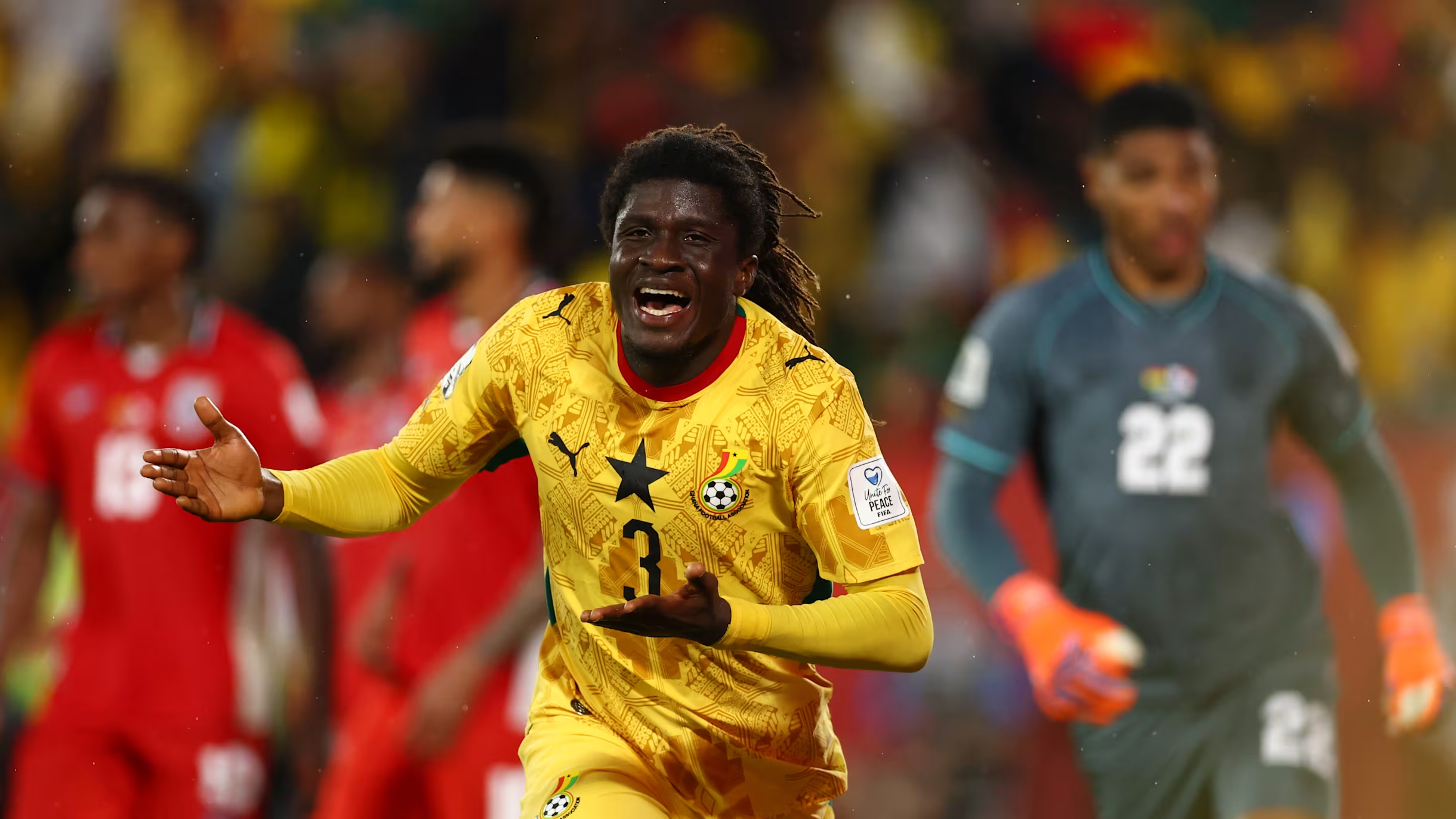
Table of Contents
In 2019, a thirteen-year-old from Bechem, a quiet town in Ghana’s Ahafo Region, walked onto a stage in Accra to collect the trophy at the National RiSE Robotics Championship. He was a slight boy with a shy smile, more comfortable wiring circuit boards than speaking into microphones. Seven years later, that same boy stood on a World Cup pitch in the United States and redirected a stoppage-time cross into the net, handing Ghana a 1-0 win over Panama and writing his name into the country’s football history. Caleb Yirenkyi did not take the obvious route to the biggest stage in the sport. He built it, piece by piece, the way he once built robots.
His father, Joshua Larbie Yirenkyi, a carpenter in Bechem, hung a banner bearing his son’s face on the wall of his workshop hours before that goal against Panama. He could not have known what was coming. By full time, the banner had become a small monument to a story rooted in sawdust, sacrifice and a teenager who refused to choose between his brain and his boots.
Picked Up at Eleven, Educated as Much as Coached
Yirenkyi was spotted at the age of eleven and brought into the Right to Dream Academy, the institution in Old Akrade that has become one of African football’s most important talent pipelines. Right to Dream is unusual. Its founding belief is that football and education are inseparable, that a young player should leave with a sharpened mind as well as a refined first touch. For most academies that is a marketing line. For Yirenkyi it was the reason he thrived.
While other boys filled their downtime with video games or extra ball work, he spent his free hours building robots. The academy did not treat this as a distraction from football. It treated curiosity as part of the package, and a boy already winning national robotics titles fit the model perfectly. The discipline that goes into engineering, the patience, the willingness to fail and rebuild, turned out to be the same discipline that makes a composed central midfielder. He learned to read systems, to anticipate, to stay calm when something breaks down around him.
Right to Dream’s track record speaks for itself. The academy and its pathway to the Danish club FC Nordsjaelland have launched the careers of Mohammed Kudus, now one of the most coveted attackers in English football, Atalanta’s Kamaldeen Sulemana and Ernest Nuamah, who moved to France. Yirenkyi followed the same road, joining Nordsjaelland and announcing himself in Scandinavian football faster than almost anyone expected.
A Breakout Season in Denmark
In the 2025/26 Danish Superliga campaign, Yirenkyi made thirty appearances, scoring twice and providing six assists from midfield. The numbers only tell part of it. His coaches named him Nordsjaelland’s Player of the Season, and the club’s supporters voted him their Player of the Year, a rare double for a player still in his teens for much of the campaign. Scouts across Europe began circling. A midfielder who can defend, carry the ball and arrive late in the box is a valuable commodity, and Yirenkyi, born in January 2006, has time on his side.
What stands out to those who have watched him closely is his temperament. He does not play like a young man overwhelmed by his surroundings. Carlos Queiroz, the vastly experienced coach who now leads Ghana and who has managed at four previous World Cups, identified Yirenkyi as ready for the biggest stage before the tournament began, trusting a twenty-year-old in a squad chasing a return to the form that once carried Ghana to within a whisker of a World Cup semi-final in 2010.
The Academy That Refuses to Choose Between Brain and Boot
To understand Yirenkyi, it helps to understand the institution that shaped him. Right to Dream was founded by Tom Vernon, a former Manchester United scout in Africa, who became convinced that the standard academy model was failing African children. The typical setup signed boys young, worked them hard, and discarded the overwhelming majority with nothing to show for their lost schooling. Vernon built something different in Ghana, a residential academy where classroom results carried as much weight as performance on the training pitch, and where a player who neglected his studies could find himself dropped regardless of talent.
That philosophy produced a culture in which a teenager building robots was celebrated rather than scolded for splitting his focus. The link to FC Nordsjaelland, the Danish club that Right to Dream’s network connected with, gave its graduates a soft landing in professional European football, a club willing to trust young players and give them minutes rather than loaning them into obscurity. Kudus, Sulemana and Nuamah all passed through that pipeline. Yirenkyi is the latest, and on current evidence he may become one of the most accomplished of them.
What separates him is the breadth of his intelligence. Coaches who have worked with him describe a player who processes the game quickly, who positions himself well before the ball arrives, and who rarely panics under pressure. Those are the qualities of someone who has spent years solving problems, whether on a circuit board or in the centre of midfield. The academy did not turn him into a footballer at the expense of the engineer. It let both grow together, and the result is a more complete young man than the system usually produces.
The Goal That Made a Nation Look Twice
Ghana arrived at the 2026 World Cup carrying the weight of a proud but bruised footballing identity. The Black Stars have not always travelled well, failing to win against European opposition in their recent World Cup outings, and there were questions about whether this squad, blending Premier League names with players from less glamorous leagues, could rediscover its swagger.
Yirenkyi’s stoppage-time finish against Panama answered some of them. The goal made him the second-youngest player ever to score for Ghana at a World Cup, behind only Haminu Draman, and it gave the Black Stars a foothold in a group containing England and Croatia. More than the three points, it was the manner of it, a young player gambling on a cross and being rewarded for his nerve, that lifted the mood around the team. Jordan Ayew, Ghana’s captain and one of the elder statesmen of the squad, has spoken about how impressive Yirenkyi has been since breaking into the senior setup, describing him as talented and exceptional in equal measure.
For a country where football carries enormous emotional and social significance, the emergence of a homegrown talent with such an unusual backstory has resonated far beyond the result. Old photographs of Yirenkyi receiving his robotics award have circulated widely in Ghana, with supporters marvelling that the boy in the picture and the boy on the World Cup pitch are the same person.
Why This Story Travels
There is a wider lesson in Yirenkyi’s rise that goes beyond Ghana. Football academies across the world wrestle with the tension between developing players and developing people. The dropout rate is brutal. For every teenager who makes it, hundreds are released, often with little to fall back on. Right to Dream’s insistence that education sits alongside football is not charity, it is a hedge against that brutality, and Yirenkyi is the argument for it made flesh. Had football not worked out, he had a mind capable of building a different future.
For Ghana, the stakes carry a particular ache. The country came closer to a World Cup semi-final than any African nation in 2010, denied by a missed penalty in the dying seconds of a quarter-final against Uruguay, a wound that still lingers in the national memory. A deep run in 2026, powered in part by a twenty-year-old who was building robots a few years ago, would offer a measure of closure to a footballing public that has waited a long time to feel that kind of hope again. Yirenkyi does not carry that history himself, which may be why he plays without its burden.
It also speaks to the changing geography of talent. The pathway from a small Ghanaian town through a Danish club to a World Cup squad would have been almost unthinkable a generation ago. Now it is a recognised route, and clubs across Europe are paying closer attention to academies in West Africa that combine technical coaching with genuine schooling. Yirenkyi is both a product of that shift and an advertisement for it.
Back in Bechem, Joshua Larbie Yirenkyi keeps working in his carpentry shop, the banner of his son still on the wall. The image captures something that statistics never will, a father who measured wood and saved what he could so that his boy could chase a dream that began with circuit boards and ended on the world’s biggest pitch. Whatever happens next for Ghana in this tournament, Caleb Yirenkyi has already given his country a story worth keeping, the one about the robotics champion who decided that football was the more interesting machine to master.

Leave a Comment
More in News

Moise Kean Will Miss Como’s Biggest Game of the Season After Cesc Fabregas Clashed With Italy’s Doctors
Oliver Glasner Returned to Crystal Palace and Fans Turned From Applause to Taunts as Forest Lost
Vinicius Red Card for Hair Pull Leaves Mourinho Snubbing the Press

Bowen’s Saved Penalty Costs West Ham a Shot at Top Spot

Cole Palmer Missed England’s World Cup Squad This Summer, and His Club Have Just Backed Him With a Deal Running to 2034
Trending on Futbol Chronicle
Mikel Arteta backs ‘warrior’ Bruno Guimarães to make Arsenal stronger
The Best Soccer Players of All Time: The 10 Greatest Ever Ranked
Celta Vigo postpones LaLiga opener after fungus outbreak damages stadium pitch
Arab football federations back Gianni Infantino as FIFA president faces growing opposition