DR Congo Reached the World Cup Knockouts 52 Years After Zaire’s 1974 Collapse
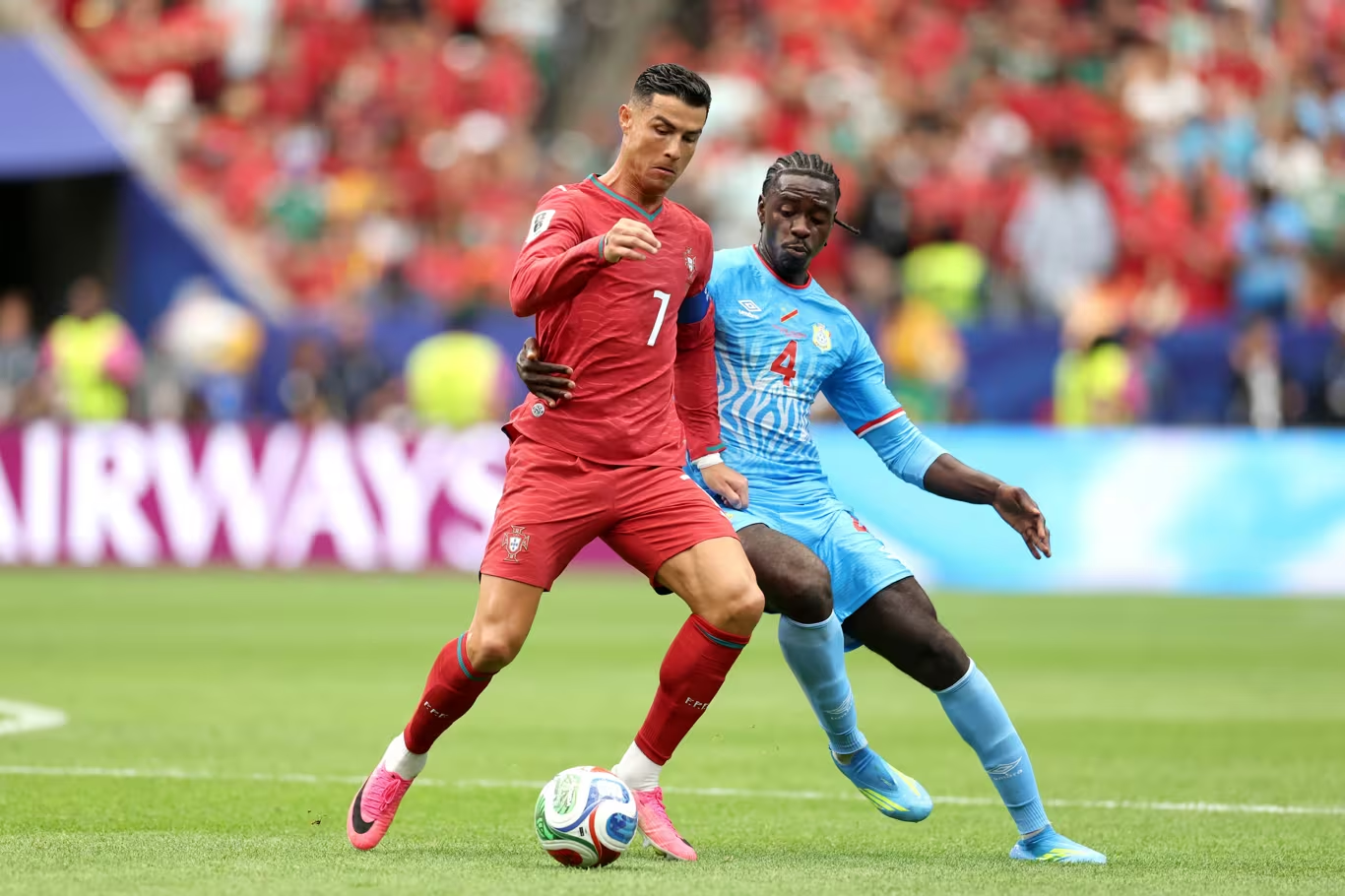
Table of Contents
Fifty two years ago, a defender named Mwepu Ilunga broke from a defensive wall and booted a Brazilian free kick down the pitch before the referee had blown his whistle. The clip became a punchline. For decades, supporters who knew nothing else about Zaire knew that single piece of footage, the African in the green shirt who apparently did not understand the rules. Ilunga spent the rest of his life correcting them. He understood the rules perfectly. He wanted to be sent off in protest, and the referee only showed him yellow.
On Saturday in Atlanta, the descendants of that team, now the Democratic Republic of the Congo, beat Uzbekistan 3-1 to reach a World Cup knockout round for the first time. The Leopards came from behind to do it, Yoane Wissa scoring twice and Fiston Mayele adding the third. The result set up a meeting with England on 1 July. It also closed a circle that began in West Germany in 1974, in one of the darkest stories the tournament has ever produced.
The team Mobutu built and then abandoned
Zaire arrived at the 1974 World Cup as champions of Africa. They had won the Cup of Nations that March, their second continental title after 1968, and the dictator Mobutu Sese Seko treated the squad as proof of the nation he wanted the world to see. Each player received a car and a house. The team trained, travelled and prepared under the gaze of a regime that had bet its prestige on them.
The bet collapsed inside a week. Zaire lost their opening game 2-0 to Scotland, a respectable result against a side that would go home unbeaten. Then came the news that the players would not be paid the bonuses they had been promised. According to accounts the surviving players gave years later, the squad considered refusing to take the field for their second match. They were warned that returning home empty handed carried consequences far worse than a defeat.
So they played Yugoslavia, and they lost 9-0. It remains one of the heaviest defeats in the history of the competition. The scoreline was not simply a gap in quality. Players have described a team that had stopped trying to win and started trying to survive the tournament, and the regime waiting at the other end of it. Mobutu, humiliated, reportedly sent word that a third heavy loss would not be forgiven.
The clip that hid the real story
That threat hung over the final group game against Brazil. Late on, with Zaire defending a free kick, Ilunga charged out and hammered the ball away. To a watching world it looked like ignorance. The truth, as he explained to journalists in the years before his death in 2015, was closer to defiance. A red card would have been a small act of rebellion, a way of telling the cameras that something was wrong without saying a word that could reach Kinshasa. The referee declined to oblige him.
Zaire lost 3-0 and flew home. Mobutu cut funding to the national side, and the football that had carried so much national hope withered. The country would not return to the World Cup for fifty two years. The Ilunga clip survived, replayed on bloopers reels by people who had no idea they were laughing at a man trapped between a dictator and a deadline.
Desabre’s Leopards and a quieter kind of history
The team that qualified this time looks nothing like a propaganda project. Sébastien Desabre, a French coach who has spent most of his career in Africa, built a side around players scattered through Europe’s leagues. Wissa, the Newcastle forward, has been the standout, his double against Uzbekistan taking him to three goals for the tournament. Mayele, Aaron Tshibola and a generation of dual nationality players raised in France, Belgium and beyond give the Leopards a depth Zaire never had.
Their group told the story of how far the side has come. DR Congo opened by holding Portugal to a 1-1 draw, frustrating a Cristiano Ronaldo team that expected three points. They pushed Colombia close before losing 1-0. Then, needing a win against Uzbekistan to go through, they fell behind and refused to fold, scoring three times to finish third in Group K. Under the expanded 48 team format, third place was enough to carry them into the last 32.
Desabre has been careful not to lean too heavily on the 1974 comparison. His players were not born when Ilunga ran from that wall. Yet the symbolism is hard to ignore. A footballing nation that was, for half a century, defined by a single afternoon of humiliation has finally given itself a different reference point.
Wissa and a squad drawn from across Europe
The face of this DR Congo side is a striker most English supporters know well. Yoane Wissa spent years in the Premier League turning himself into a reliable goalscorer, learning his trade in the grind of English football before becoming the focal point of his country’s attack. Born in France to Congolese parents, he is one of a generation of dual nationality players who could have chosen a European nation and instead committed to the Leopards. His three goals at the tournament have done more than any speech to announce that DR Congo arrived to compete.
He is not alone. Desabre’s squad is a patchwork of players raised in France, Belgium and beyond, men who grew up in European academies and chose the country of their heritage when the call came. That model has transformed African football over the last two decades. Nations that once relied solely on home based talent now field squads stocked with players from the top divisions of Europe, fluent in the tactical demands of the modern game and unafraid of any opponent. Morocco’s run to the semi finals in 2022 was built on exactly this foundation, and DR Congo have followed the template.
What that means in practice is a team comfortable on the ball, organised without it and physically equipped to trouble anyone. Against Portugal they sat deep and struck on the break. Against Uzbekistan they showed they could chase a game and win it. Desabre has given them a clear identity, and the players have bought into it. For a federation that has lurched through years of administrative chaos and unpaid wages, the on field discipline is its own small miracle, an echo of 1974 that this time has a happier ending.
What waits in Atlanta
England stand in the way, and the gap in resources between the two squads is vast. Thomas Tuchel’s side topped Group L with seven points, beating Croatia and Panama and drawing with Ghana. They will start as heavy favourites at the Mercedes-Benz Stadium, the same ground where DR Congo beat Uzbekistan, with kick off at 5pm BST.
The Leopards will not mind the role. Everything about their group stage suggested a team that plays better when written off, organised in defence, dangerous in transition and willing to chase a game it appears to be losing. Wissa knows the English game intimately from his years in the Premier League. He will face defenders he has spent seasons trying to beat, and he will do so for a country reaching this stage for the first time.
A continent that no longer waits for permission
DR Congo’s run fits a wider shift at this World Cup. The 48 team field gave Africa nine places, and several of them have been used to puncture old assumptions. Cape Verde, a nation of half a million people, stunned Spain. South Africa reached a knockout round for the first time. The continent that was once handed a single token slot now sends teams that expect to be here and behave as though they belong.
For DR Congo, the progress carries an extra weight because of where the team started. The 1974 squad were used and discarded by a regime that cared about the football only as long as it flattered the leader. The 2026 team plays for a country still wrestling with conflict and instability in its east, where football remains one of the few things capable of uniting people across a vast and divided land. A run to the last 16, or beyond, would mean something well outside the result column.
There is a generation in Kinshasa and across the diaspora that grew up hearing about 1974 only as a cautionary tale, a story of talented players crushed by a dictator and reduced to a bad joke on foreign television. Reaching the last 32 hands those supporters a new memory to pass down, one in which the Leopards are the ones doing the surprising. A win over England would turn it into something far bigger, the kind of result that replays for decades and reframes how a country sees its own football.
Ilunga did not live to see it. He died in 2015, still occasionally asked about the free kick, still patiently explaining that he had known exactly what he was doing. The men who will walk out against England never met him. They carry his story anyway, whether they think about it or not. The shirt is the same colour, the country has a different name, and for the first time in fifty two years the football is the part people are talking about.

Leave a Comment
More in News

Thierno Barry Was Filmed Crying In A Private Training Session Last Season, And He Has Already Scored In Three Games This Campaign
Gravenberch’s Red Card Sparks Referee Row in Liverpool’s Defeat to City

Moise Kean Will Miss Como’s Biggest Game of the Season After Cesc Fabregas Clashed With Italy’s Doctors
Oliver Glasner Returned to Crystal Palace and Fans Turned From Applause to Taunts as Forest Lost
Vinicius Red Card for Hair Pull Leaves Mourinho Snubbing the Press
Trending on Futbol Chronicle
Michael Carrick points to lack of sharpness after Manchester United draw with West Ham
Mikel Arteta backs ‘warrior’ Bruno Guimarães to make Arsenal stronger
Why Soccer Is The Best Sport
Michael Carrick admits Manchester United have “no excuses” after AC Milan defeat