Sixteen Million Americans Watched the USMNT Beat Paraguay and Set a Television Record
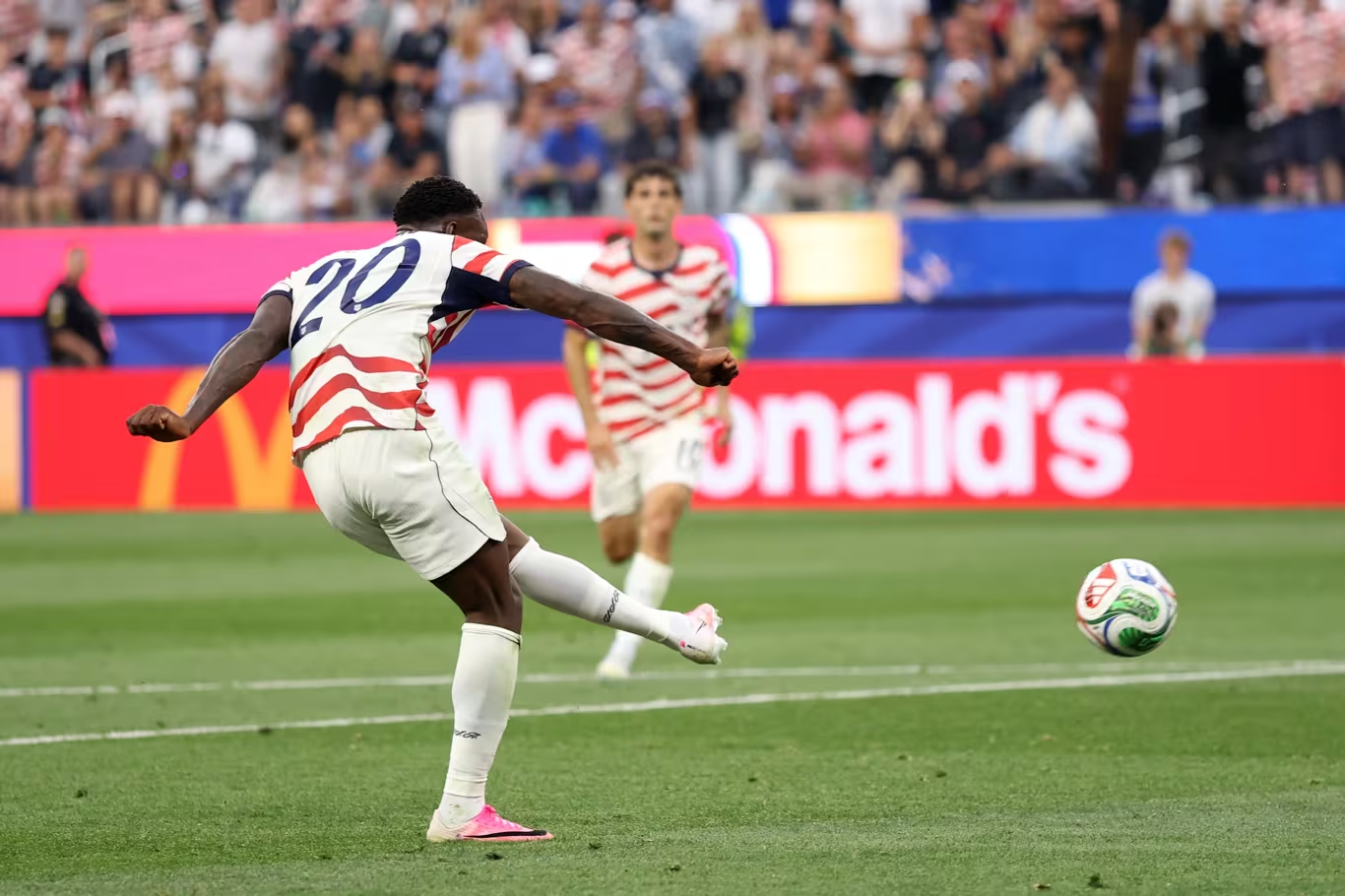
Table of Contents
For one night in Inglewood, the United States men’s national team was the biggest show in the country. When Christian Pulisic and his teammates ran out at SoFi Stadium on Friday and tore Paraguay apart in a 4-1 win, an average of 15,986,000 people were watching on Fox, Fox One and Tubi. By the time the broadcast peaked between 10:45 and 11 p.m. Eastern, that figure had climbed to 18,860,000. According to Fox, it was the most-watched USMNT telecast in history, and the most-watched men’s World Cup group stage game ever shown in English in the United States.
Add the 8.9 million who watched the Spanish-language broadcast on Telemundo and Peacock, as Yahoo Sports’ Steven Goff did, and the total audience for one soccer game involving the American men landed close to 25 million. For a sport that has spent decades being told it would never truly arrive here, that number is the loudest answer yet.
A Record Built on a Performance
The audience showed up, but the team gave them a reason to stay. The Americans scored four goals, the most they have ever managed in a World Cup match. They controlled the ball for 65 percent of the game, completed 598 passes to Paraguay’s 319, and outshot their opponents 16 to 9. This was not a nervous host nation grinding out a result. It was a young side playing with the freedom of a team that believes it belongs.
Pulisic was at the center of it, meeting the moment before a late knock to his calf brought a wave of anxiety. “I’m really hoping that it’s nothing,” he said afterward, and his availability for the next match instantly became the talking point of the week. For ninety minutes, though, the captain looked like the player American soccer has always hoped he could be on the grandest stage, and the viewing figures suggest the country was paying attention.
How Big Is 16 Million, Really
To understand the scale, look at where the USMNT started this cycle. At the 2022 World Cup in Qatar, the team’s opening game, a 1-1 draw with Wales, averaged 7,763,000 viewers. Friday’s number was up 106 percent on that. Part of the jump is obvious. Qatar meant inconvenient kickoff times for American audiences, while this tournament is being played in their own time zones, with a Friday night slot that could not have been better placed.
There is also a measurement story worth being honest about. Nielsen shifted to a new methodology last fall that blends its traditional panel with what it calls Big Data pulled from smart televisions and set-top boxes. This is only the second World Cup measured with out-of-home viewing included, which captures the crowds watching in bars, restaurants and at parties rather than only living rooms. Those changes inflate the comparison with older tournaments, and any serious look at the figures has to account for them.
That caveat fed a small dispute among media analysts. Some pointed out that the USMNT’s 2-2 draw with Portugal at the 2014 World Cup drew higher reported numbers on its broadcaster. As Richard Deitsch of The Sports Media Podcast noted, the two networks used different telecast figures to calculate their ratings, which is why both can plausibly claim a record. “Both likely will claim the record,” Deitsch wrote. The honest summary is that Friday’s game was either the most-watched USMNT match ever or very close to it, depending on which set of numbers you trust. Either way, it is enormous.
The Tournament Was Already Breaking Records
The American men did not start this trend. The tournament opener three days earlier, a Thursday afternoon meeting between Mexico and South Africa in Mexico City, averaged 6,309,000 viewers on Fox. That made it the most-watched men’s World Cup opening match and the most-watched non-USMNT group stage telecast in English-language American history. On Telemundo, the Spanish-language broadcast of Mexico’s 2-0 win became the biggest Spanish-language soccer telecast the country has ever recorded.
The pattern is clear. With the World Cup on home soil, every meaningful number is climbing, and the games involving the host nation are pulling audiences that rival the biggest events on the American calendar. Soccer is no longer competing for scraps of attention. For these few weeks it is sitting at the main table.
Why This Moment Is Different
Americans have had soccer breakthroughs before. The 1994 World Cup, also held here, set attendance records that still stand and is often credited with the birth of Major League Soccer. The 1999 Women’s World Cup final and Brandi Chastain’s penalty became a cultural landmark. The difference now is the infrastructure underneath the moment. There is a domestic league in its fourth decade, a generation of players developed in Europe’s best academies, and a streaming and broadcast ecosystem that makes the game easier to find than ever.
There is also the country’s own makeup. The United States is home to the largest soccer-loving diaspora on the planet, communities from Mexico, Central America, the Caribbean, West Africa and beyond who already treat the sport as part of daily life. The 25 million who watched across two languages on Friday were not converts discovering soccer for the first time. Many of them have been here all along, waiting for the national team to give them a night worth shouting about.
The challenge, as always, is what happens when the tournament ends. Past spikes faded once the World Cup left town. The bet US Soccer and its broadcasters are making is that a deep run by an exciting young team, watched by tens of millions, will leave behind fans who keep watching in the autumn when the stakes are lower and the opponents less glamorous.
What the Numbers Mean for the Business
Ratings of this size carry consequences far beyond bragging rights. Fox paid heavily for the English-language rights to this World Cup, and a host-nation run that delivers audiences near 20 million per game turns that investment into a windfall. Advertisers chase the rare moments when tens of millions of Americans watch the same thing live, because so little of modern television still does that. A deep USMNT run gives them exactly that, night after night, in prime time.
The streaming side of the story is just as telling. Fox folded its Tubi and Fox One figures into the total, a sign of how much live sports viewing has moved off traditional cable. Telemundo’s parent leaned on Peacock to push its Spanish-language audience close to nine million. The World Cup is functioning as a showcase for every way Americans now watch sport, and the early evidence is that they will follow the national team across all of them. For executives planning the next decade of rights deals, those habits are worth more than any single night’s headline figure.
The comparison advertisers care about is not other soccer games but the wider television calendar. A 19 million peak puts a group stage soccer match in the same conversation as playoff baseball, marquee college football and award shows, the small handful of broadcasts that still gather a mass live audience. That the USMNT can now sit in that company, even for one Friday in June, reshapes how the sport will be valued when the next round of media negotiations begins.
The Players Felt the Shift
Inside the squad, the noise did not go unnoticed. American players who have spent their careers explaining the sport to skeptical relatives suddenly found those same relatives glued to the broadcast. The diaspora crowds inside SoFi Stadium gave the night the feel of a genuine home tournament rather than a curiosity, and the energy carried through the television feed into living rooms and sports bars across the country.
For a generation of players raised on the promise that 2026 would change everything, Friday was the first real proof. They had been told the home World Cup would be the moment soccer stopped apologizing for itself in America. Then 25 million people watched them win, and the promise stopped being a slogan and started being a scoreboard. Whatever happens in the knockout rounds, that first night gave the players evidence that the audience they were promised actually exists.
The Road From Here
The schedule offers two more chances to grow the audience. The Americans face Australia on Friday, June 19, in Seattle, then close the group stage against Turkey on Thursday, June 25, back in Inglewood. If Pulisic’s calf holds up and the team keeps winning, there is no reason the numbers cannot climb again, particularly with the knockout rounds and their win-or-go-home drama still to come.
Television ratings are a strange thing to celebrate. They do not win matches or lift trophies. But they are the clearest measure of whether a sport has lodged itself in the national imagination, and on Friday night the answer was impossible to ignore. Close to 25 million people chose to spend their evening with the US men’s national team. For a program that has so often played to indifference at home, that is the kind of number that changes the conversation. The players gave the country a performance worth watching. The country, for once, watched in numbers no one in American soccer can ever take for granted again.

Leave a Comment
More in News
Michael Carrick Kept His Cool When the Pitchforks Came Out, and Manchester United Rewarded Him for It

Cavan Sullivan Ties Freddy Adu’s MLS Record With Winner for Philadelphia Union

Gabriel Jesus Set for Barcelona Medical as Arsenal Deadline Day Exodus Continues

Ollie Watkins Completes £51m Al-Hilal Move With Emotional Farewell to Aston Villa

Three Tottenham Players Ask to Leave as De Zerbi’s Rebuild Unravels
Trending on Futbol Chronicle

Michael Carrick points to lack of sharpness after Manchester United draw with West Ham
Map of All the Premier League Teams for 2025/26
Michael Carrick admits Manchester United have “no excuses” after AC Milan defeat
What Is Offsides in Soccer? The Offside Rule Fully Explained